Underglow installation in Central New York can give a car, truck, SUV, Tesla, or custom build a completely different appearance after dark. Before choosing colors and lighting effects, New York drivers need to understand that state law places tight limits on lights added to vehicles. A color that looks great at a show may not be allowed on a vehicle used on a public highway.
At Notorious Auto Protection in Syracuse, NY, we provide vehicle underglow installation with weather-resistant lighting systems, concealed wiring, smartphone controls, color choices, and lighting effects. Our shop works with drivers from Syracuse, NY, North Syracuse, NY, East Syracuse, NY, Cicero, NY, Liverpool, NY, Clay, NY, Fayetteville, NY, and communities across Central New York.
Here is what matters before planning your lighting: New York Vehicle and Traffic Law Section 375 places restrictions on the color and behavior of lights added to vehicles. Section 376 also requires vehicle lights to meet state approval rules. A clean installation and a road-legal lighting configuration are two separate parts of planning an underglow project.
Underglow installation in Central New York needs to be planned around New York’s rules for lights that are not required equipment.
New York Vehicle and Traffic Law Section 375, subdivision 41, covers colored and flashing lights added to vehicles. The current law states that no light other than white may be affixed to or displayed on a vehicle unless one of the listed exceptions applies.
Those exceptions cover certain emergency, volunteer fire, ambulance, hazard, police, and related vehicles.
For an ordinary privately owned passenger vehicle, that makes steady white the color that fits the statute’s general rule for added lighting.
There is another part of the law to remember.
New York Vehicle and Traffic Law Section 376 states that lights, signals, and reflectors must be of a type and design approved by the Commissioner of Motor Vehicles.
For that reason, saying “white underglow is always legal” is too broad.
The safer way to read New York law is that an ordinary private vehicle should not have non-white auxiliary lighting affixed or displayed, flashing or moving white lighting is restricted, and vehicle lighting still needs to meet the state’s equipment rules.
For an ordinary private vehicle, New York VTL §375(41) starts with a simple rule: added vehicle lights must be white unless the vehicle falls within an exception written into the statute.
That means drivers considering underglow installation in Central New York should be cautious with:
Some of these colors are connected with emergency, volunteer, or hazard vehicles under New York law.
Do not assume that a color is road-legal just because an underglow controller allows you to select it.
An RGB kit and the way you use it are not the same issue. The statute covers both affixing and displaying lights, which is one reason drivers should take color restrictions seriously before installing a multi-color exterior lighting system.
Steady white lighting is the color permitted by the general language of New York VTL §375(41)(1) for lights added to ordinary vehicles.
There are still conditions to consider.
The law does not allow a white auxiliary light to revolve, rotate, flash, oscillate, or move continuously unless an exception applies.
New York VTL §376 also states that vehicle lights must be of a type and design approved by the Commissioner.
What this means for underglow installation in Central New York is that white is the starting point for a road-conscious setup, but color alone does not answer every legal question.
The fixture, installation, light behavior, brightness, placement, and state equipment requirements can still matter.
If your goal is to use underglow on public roads, a steady white setup presents fewer color-related issues than an RGB system running red, blue, green, purple, or another color.
Red auxiliary lights are restricted under New York law.
VTL §375(41) allows red or red-and-white warning lights on authorized emergency vehicles under listed conditions.
That is not the same as allowing a private passenger car to display red underglow.
For owners planning underglow installation in Central New York, red should not be treated as a normal road-use color.
This matters even when the light is mounted beneath the vehicle rather than on the grille or roof.
The law addresses lights affixed to or displayed on vehicles, not only traditional light bars.
If a multi-color underglow system includes red for display use, speak with the installer about controls and how you intend to use the system.
Blue is one of the clearest colors to avoid on an ordinary private vehicle.
New York VTL §375(41) gives blue-light authority to certain vehicles and users, including authorized volunteer firefighters and certain emergency or hazard vehicles under stated conditions.
The statute says blue-light use is restricted except where its listed provisions allow it.
A privately owned vehicle does not gain permission to display blue underglow simply because the lights are installed underneath the chassis.
For underglow installation in Central New York, blue lighting should be considered a show or off-road/private-property discussion rather than a public-road color unless you have legal authority that fits the statute.
Green vehicle lights also receive special treatment under New York law.
VTL §375(41) allows green lights for certain volunteer ambulance-service members and other listed users under defined conditions.
That does not give ordinary passenger vehicles permission to display green exterior accent lights on public roads.
Drivers considering underglow installation in Central New York should not assume green is acceptable because it does not look like a traditional police color.
New York’s statute does not simply ban blue while leaving every other color open.
Its general rule is white, with separate exceptions for defined vehicle classes and users.
Amber is commonly associated with hazard and service vehicles. New York VTL §375(41) contains rules allowing amber warning lights on certain hazard vehicles and during defined operations.
Purple, pink, teal, and other aftermarket colors may not have their own named section, but that does not mean they are automatically permitted.
Remember the starting rule: for non-required lights, New York says no color other than white may be affixed or displayed unless the statute provides an exception.
For that reason, underglow installation in Central New York should not be approached with the idea that “anything except red and blue is legal.”
That common rule of thumb does not match the language of New York VTL §375(41).
For normal road use on a private vehicle, steady white is the color that fits the statute’s general rule.
New York law also restricts how added white lights behave.
VTL §375(41)(1) bars white lights that revolve, rotate, flash, oscillate, or constantly move unless a statutory exception applies.
That matters because many modern underglow kits can do far more than display one steady color.
Depending on the system, you may have:
Notorious Auto Protection’s vehicle underglow installation can include systems with color, pattern, brightness, smartphone, and music-sync controls.
Those features may be useful for shows, photos, meets, or private-property display, but having a feature available does not mean every mode is permitted while driving on a New York public highway.
For public-road use, steady lighting avoids the flashing and moving-light restrictions found in §375(41).
New York does not need to use the word “underglow” for its lighting rules to apply.
Section 375(41) governs colored and flashing lights other than lights required by law.
The current statute says:
This is why underglow installation in Central New York needs more thought than simply picking a favorite color from an app.
The physical lighting system and the mode used on public roads both matter.
New York’s law was most recently revised on August 28, 2026, so older online summaries may not reflect the current text.
When a lighting law question could affect a ticket, inspection issue, or roadside stop, the current statute is the better source.
Section 376 adds another layer to New York vehicle-lighting rules.
It states that vehicle lights, signaling devices, and reflectors must be of a type and design approved by the Commissioner of Motor Vehicles.
It also gives the Commissioner authority over areas such as:
The statute also limits lights above 32 candlepower unless the light is an approved type.
For someone considering underglow installation in Central New York, this means color is not the only question.
A person can choose steady white and still need to think about whether the lighting equipment and its use fit New York requirements.
This article provides general information about the law. It is not legal advice. If you need a legal determination for a particular kit or planned road use, speak with New York DMV, local law enforcement, or a New York attorney familiar with vehicle equipment law.
RGB kits are popular because a smartphone or remote can change the color in seconds.
That flexibility also creates a legal question.
New York VTL §375(41) does not only discuss displaying colored lights. It says that, outside its exceptions, no light other than white may be affixed to or displayed on a vehicle.
Because an RGB fixture can produce colors beyond white, drivers who intend to operate on public highways should not assume that selecting white mode automatically resolves every issue with the hardware.
This is an area where a lawyer or DMV interpretation may matter if you need a firm answer about a particular RGB product.
From a practical standpoint, keep public-road use separate from show settings.
If you choose underglow installation in Central New York with color-changing controls, understand that having access to red, blue, green, moving patterns, or flashing modes does not mean those settings are lawful on public roads.
New York’s Vehicle and Traffic Law provisions discussed here focus heavily on vehicles operated, driven, parked, or equipped for public highway and street use.
Private property can involve different circumstances.
A closed car show, private meet, private driveway, display area, or off-road event may not present the same situation as driving down a public road.
The catch is that the location matters.
A parking lot that feels private may still have rules imposed by the property owner or local law. A vehicle parked on a public street remains in a different situation from a vehicle displayed inside a private event space.
If you want colored underglow installation in Central New York mainly for shows and meets, talk about that use when planning the system.
Smartphone-controlled lighting lets you select different colors and modes, but the driver remains responsible for using the system within applicable law.
New York’s inspection rules and New York’s road-use laws are related, but they are not identical.
The current DMV inspection regulations list the lighting equipment inspectors must check, including headlamps, tail lamps, stop lamps, directional signals, hazard lights, backup lights, and the license-plate lamp.
The inspection regulations also address supplementary exterior lighting.
Passing an inspection should not be treated as proof that every underglow color or lighting mode is lawful to display on public roads.
VTL §§375 and 376 still govern vehicle equipment and lighting.
That distinction matters when planning underglow installation in Central New York.
If road legality is your goal, consider the statute, the equipment rules, and the way the lights will actually be used rather than relying only on whether a vehicle passes inspection.
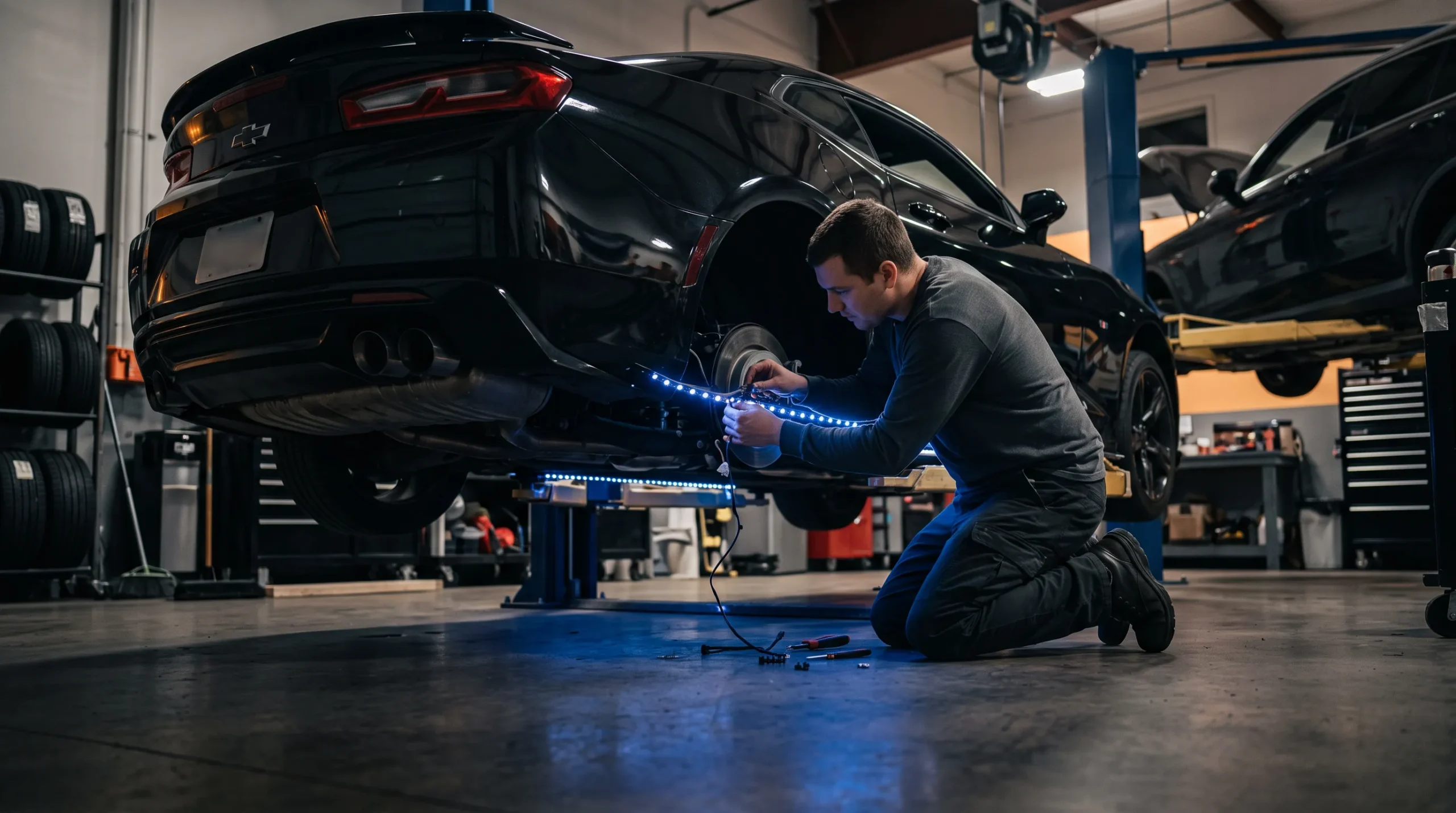
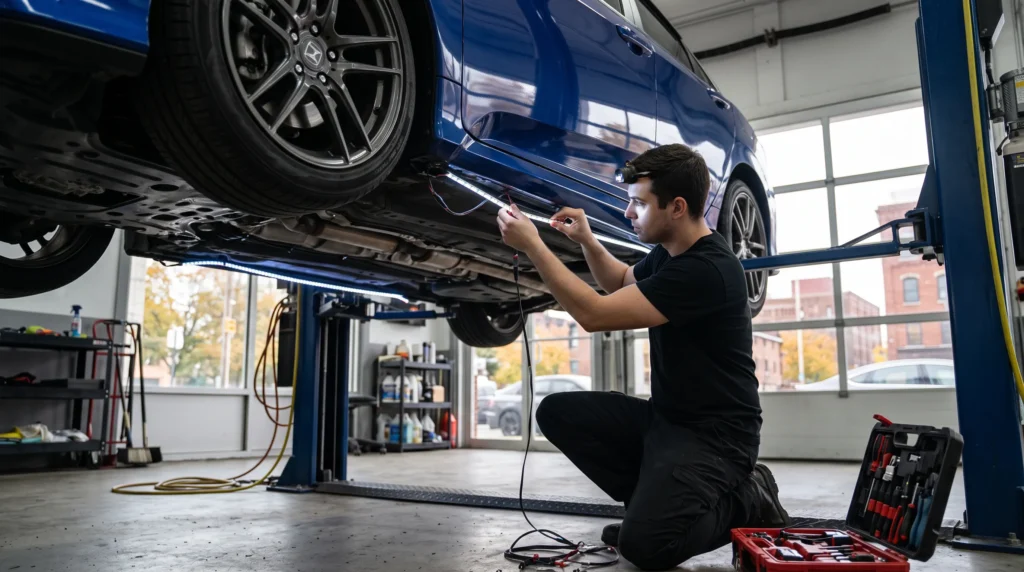
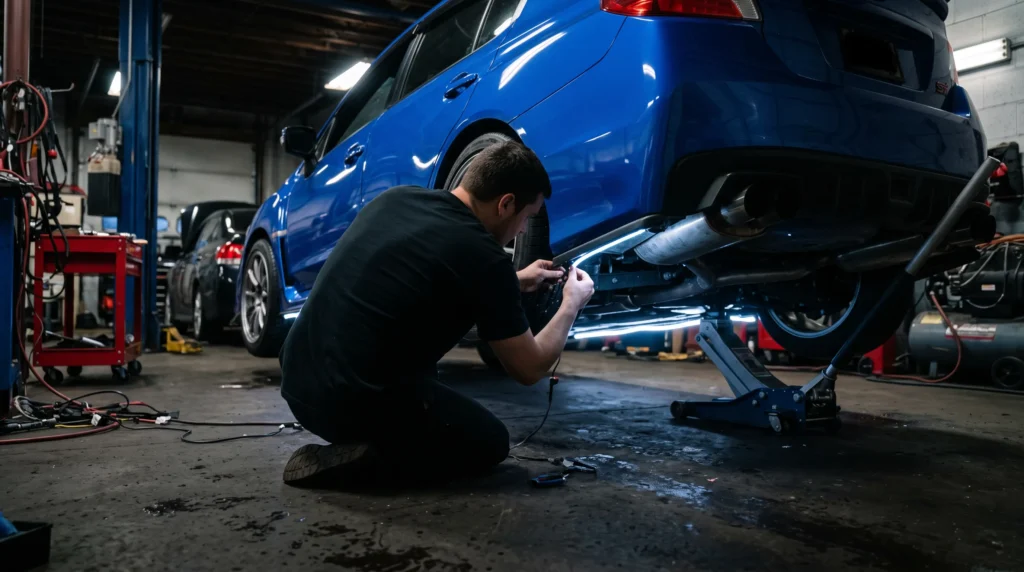
A clean underglow setup needs more than LED strips attached beneath the vehicle.
Notorious Auto Protection installs lighting around the underbody while accounting for the shape of the vehicle, mounting locations, ground clearance, wiring, road exposure, and controller placement.
A typical project may involve:
Most underglow installations at Notorious Auto Protection are completed within 2 to 4 hours, depending on the vehicle and the amount of work involved.
The finished system may offer color changes, patterns, brightness controls, music-sync effects, and smartphone operation.
Road use still needs to stay within New York’s lighting rules.
Underglow installation in Central New York has to deal with conditions that an interior lighting system never sees.
The lights sit beneath the vehicle where they can be exposed to:
Central New York winters make mounting and wiring placement especially worth thinking about.
Notorious Auto Protection uses underglow systems intended for exposure to weather and road conditions.
The lighting strips also need to stay away from areas that could create problems, including moving suspension pieces, exhaust heat, service points, and locations likely to be struck by road debris.
A lowered vehicle may need a different lighting layout from a lifted truck.
Tell the shop about suspension changes when scheduling.
Underglow can be installed on many types of vehicles.
Possible candidates include:
The installation changes with the vehicle.
A low sports car may have limited clearance underneath. A lifted truck can have much more space between the chassis and the road, changing how the light spreads.
SUVs can have longer wheelbases and different underbody panels.
Truck owners planning other lighting work can also view our truck lighting service.
Owners planning a larger project can visit our vehicle modifications page.
The underglow should be planned around the actual vehicle rather than copied from another build.
Notorious Auto Protection provides underglow installation in Central New York from our Syracuse, NY shop.
Our location is:
Notorious Auto Protection
6742 Pickard Dr
Syracuse, NY 13211
We work with vehicle owners from Syracuse, NY and nearby communities such as:
If you are planning a color-changing system, tell us how you expect to use it.
A show-focused vehicle can have different needs from a daily driver where the owner wants a steady road-use setting.
Start with how you plan to use the vehicle.
If your main goal is public-road driving, New York’s steady-white rule should be part of the discussion from the beginning.
If the vehicle is being built mainly for shows, private meets, photographs, or closed-property display, you may care more about RGB colors and lighting patterns.
Either way, think about:
Do not treat an app’s available color menu as a list of legally approved road colors.
The controller may allow dozens of colors even when state law allows far fewer options on a public highway.
For questions about a particular light or vehicle configuration, check the current New York statutes and speak with the proper state or legal source.
Underglow installation in Central New York can add a strong nighttime look to a car, truck, SUV, Tesla, or show vehicle, but the lighting should be planned with New York law in mind.
For ordinary privately owned vehicles, New York VTL §375(41) makes white the general color for added lights and restricts rotating, flashing, oscillating, and continuously moving white lighting. Separate equipment rules under §376 also apply.
Notorious Auto Protection installs weather-resistant underglow systems with concealed wiring and lighting controls from our Syracuse, NY shop.
Call (315) 552-4441 to discuss your vehicle.
You can also visit our contact page to request an appointment.
Tell us:
Our team can discuss the installation and the lighting features available for your vehicle.
New York allows only white as the general color for lights added to ordinary private vehicles under VTL §375(41), unless a listed exception applies. Flashing, rotating, oscillating, or continuously moving white auxiliary lights are also restricted. Section 376 contains separate approval requirements for vehicle lights.
For an ordinary privately owned vehicle, steady white is the color that fits the general rule in VTL §375(41). Red, blue, green, amber, purple, and other colors should not be treated as normal public-road underglow colors.
Blue vehicle lighting is restricted to users and vehicles authorized under New York law, such as certain volunteer firefighters and emergency or hazard vehicles under defined conditions. Ordinary private vehicles should not use blue underglow on public roads.
Red auxiliary lighting is associated with authorized emergency vehicles under VTL §375(41). It should not be treated as a legal public-road underglow color for an ordinary passenger vehicle.
New York restricts revolving, rotating, flashing, oscillating, and continuously moving added white lights unless an exception applies. Color-changing and moving underglow effects should not be assumed to be lawful during public-road use.
New York’s statute covers lights that are affixed as well as displayed, so an RGB system capable of non-white colors raises a legal question beyond simply choosing white mode. Drivers who need a firm answer about a particular kit should check with New York DMV or a New York attorney familiar with vehicle equipment rules.
Call Notorious Auto Protection at (315) 552-4441 or visit our contact page. Tell us your vehicle’s year, make, model, ground clearance, preferred lighting setup, and how you plan to use the underglow.
Your vehicle is a significant investment, and ensuring its protection from the elements and everyday hazards is crucial to maintaining its value and appearance. In Syracuse, NY, where road conditions and weather can be unpredictable, combining STEK Paint Protection Film (PPF) and Window Tint offers the ultimate solution for safeguarding your car. At Notorious Auto Protection, we specialize in applying these premium products to provide your vehicle with maximum protection and enhanced aesthetics.
Product Brand: Auto Protection
Question about the service you're choosing, or simply ready to book? Contact us today to get started
Explore the many services we offer by clicking the boxes below