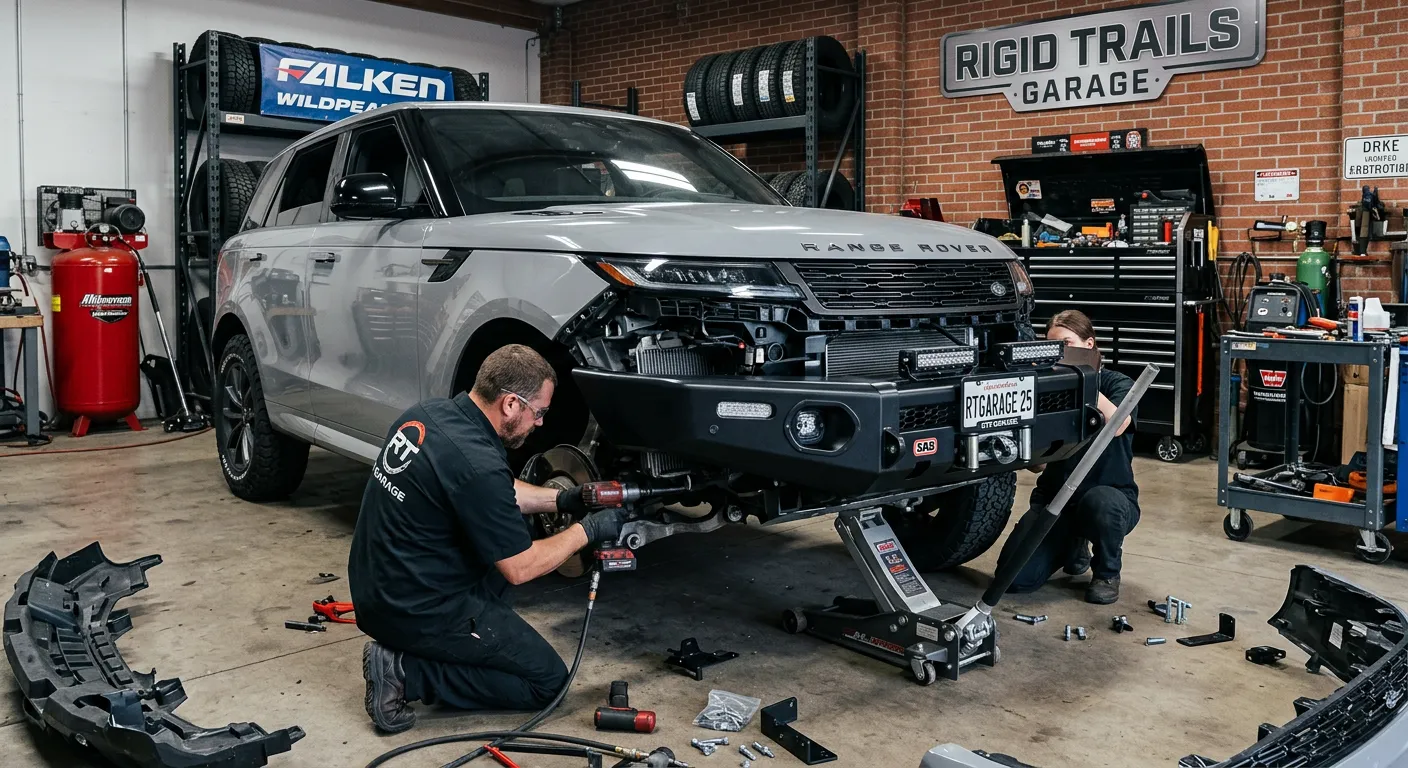
Aftermarket Bumper Installation for Trucks & Jeeps can change much more than exterior styling. The right bumper can add a winch mount, recovery points, auxiliary-light locations, added clearance, or a different approach angle. It can also add considerable weight and affect factory equipment mounted around the front or rear of the vehicle.
That makes fitment the first concern.
A bumper should be selected for the exact year, make, model, and configuration of the truck or Jeep. Winch compatibility, parking sensors, cameras, factory fog lights, radar equipment, tow hooks, skid plates, and mounting hardware can all affect the installation.
Notorious Auto Protection provides bumper installation in Syracuse, NY. We also offer winch installation, truck lighting, and other truck modification services for drivers planning a larger build.
Before choosing a bumper because you like how it looks, make sure it works with the rest of your vehicle.
An aftermarket bumper replaces or changes the original front or rear bumper system.
There are many designs.
Some focus on appearance.
Others are built around off-road use, winch mounting, recovery equipment, auxiliary lights, or additional clearance.
Depending on the bumper, features may include:
WARN’s current truck and Jeep bumper lineup shows how much these features can differ. Its catalog includes full-width and stubby designs, integrated winch mounts, lighting ports, recovery points, camera retention, and vehicle-specific fitment.
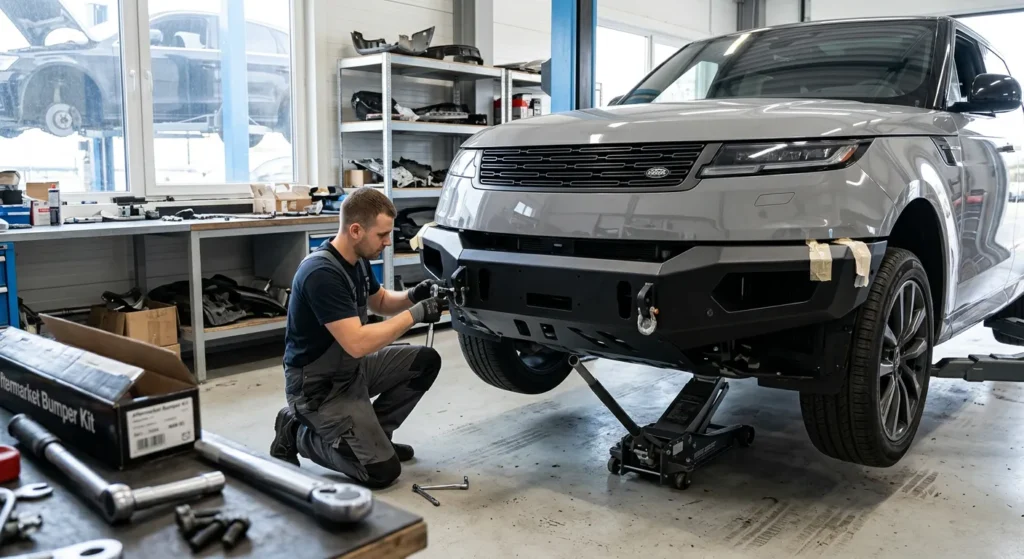
The right combination depends on what you want the vehicle to do.
Front and rear bumpers solve different problems.
A front bumper may provide:
The front of the vehicle can also contain parking sensors, cameras, fog lights, radar equipment, and other electronics.
Those items need to be considered before installation.
Rear bumper designs can include:
Check how a rear bumper works with the trailer hitch, backup sensors, camera system, exhaust, and spare tire.
Do not assume a front and rear bumper from the same product line will require the same installation process.
Material affects bumper weight, construction, and corrosion characteristics.
Steel is widely used for off-road bumpers.
WARN’s Ascent truck bumpers use steel construction with a textured powder-coated finish. The company states that its current Ascent designs use 11-gauge steel and undergo salt-spray testing for the finish.
Steel can provide a stout structure for equipment such as winches and recovery points when the bumper was engineered for those uses.
Aluminum bumpers are another option.
They can reduce weight compared with some steel designs, though the actual difference depends on the products being compared.
Do not judge strength or intended use from material alone.
Check:
A steel bumper is not automatically designed for winching, and an aluminum bumper is not automatically unsuitable for off-road use.
Full-width bumpers extend across much of the vehicle’s front or rear.
They can provide broad coverage and a substantial appearance.
High-clearance designs may reduce material around the outer corners or position the bumper closer to the body.
That can help create more room around obstacles or larger tires.
Jeep provides a useful factory-backed version of this idea.
Mopar’s Rubicon steel front bumper for the Jeep Wrangler and Gladiator uses removable ends, allowing it to be changed from a longer configuration to a narrower high-clearance setup.
Think about where the vehicle will be driven.
A daily-driven truck and a Jeep that regularly travels on tight trails may call for different bumper shapes.
Approach angle describes how steep an obstacle a vehicle can approach before the front of the vehicle contacts it.
Bumper shape can influence this measurement.
A bumper that hangs low or projects far forward may contact an obstacle sooner.
WARN states that its Ascent bumper design sits high to maintain ground clearance and approach angle.
That type of design can matter for vehicles used on:
Approach angle is only one part of off-road clearance.
Tire size, suspension height, wheelbase, breakover angle, and departure angle also affect how the vehicle moves across terrain.
Still, the bumper can make a noticeable difference at the front of the vehicle.
A winch-ready bumper includes a mounting arrangement designed for compatible winches.
Do not assume every heavy-looking steel bumper is winch-ready.
WARN’s Ascent bumpers, as one current manufacturer reference, include integrated winch mounts and are designed around compatible mid-frame WARN winches up to 12,000 pounds on listed applications.
A winch-ready bumper may include:
The winch still needs to fit the bumper.
Check the winch’s:
If you plan to add a winch, choose the bumper and winch together.
Notorious Auto Protection provides winch installation along with bumper installation.
A bumper may have a maximum compatible winch capacity.
Do not exceed the bumper manufacturer’s stated limit.
WARN’s current Ascent applications commonly list compatibility with selected mid-frame winches up to 12,000 pounds.
WARN also offers Jeep-specific winch carriers. Its current Wrangler JL and Gladiator JT carrier is engineered for 12,000-pound pulls and is designed around a defined group of compatible winches.
This shows why the bumper, mounting plate, and winch cannot be chosen independently.
The winch rating needs to suit the vehicle.
The mounting system needs to suit the winch.
The bumper needs to suit the mounting arrangement.
Treat them as one recovery setup.
Recovery points are another common reason truck and Jeep owners change bumpers.
Some aftermarket bumpers include welded points intended for compatible shackles.
WARN lists welded recovery points on several of its current Ascent bumpers.
Mopar’s Jeep Performance Parts steel front bumper is also offered with recovery hardware as part of its off-road design.
Do not confuse a decorative opening with a recovery point.
Likewise, do not assume every factory transport point, tie-down point, or bumper opening is intended for vehicle recovery.
If recovery is part of your plan, check:
Recovery equipment is subjected to substantial forces.
Use components for the job they were designed to perform.
Many aftermarket bumpers provide dedicated openings or mounting tabs for auxiliary lighting.
WARN’s current Ascent front bumpers include integrated ports for auxiliary flood or spot lights.
This can produce a cleaner installation than drilling random holes into a finished bumper.
Possible bumper-mounted lighting includes:
The lights still need proper wiring, switching, mounting, and road-use consideration.
Notorious Auto Protection provides truck lighting and light bar installation for truck owners planning exterior lighting changes.
Plan the lighting before the bumper goes on when possible.
Wire routing can be easier when the bumper is already removed.
If your truck or Jeep has factory fog lights, check whether the replacement bumper retains them.
Some aftermarket bumpers include locations for factory-style lighting.
Others require different lights.
Mopar’s Jeep Performance Parts bumper documentation lists compatible LED fog lamps for its bumper system.
Ask before installation:
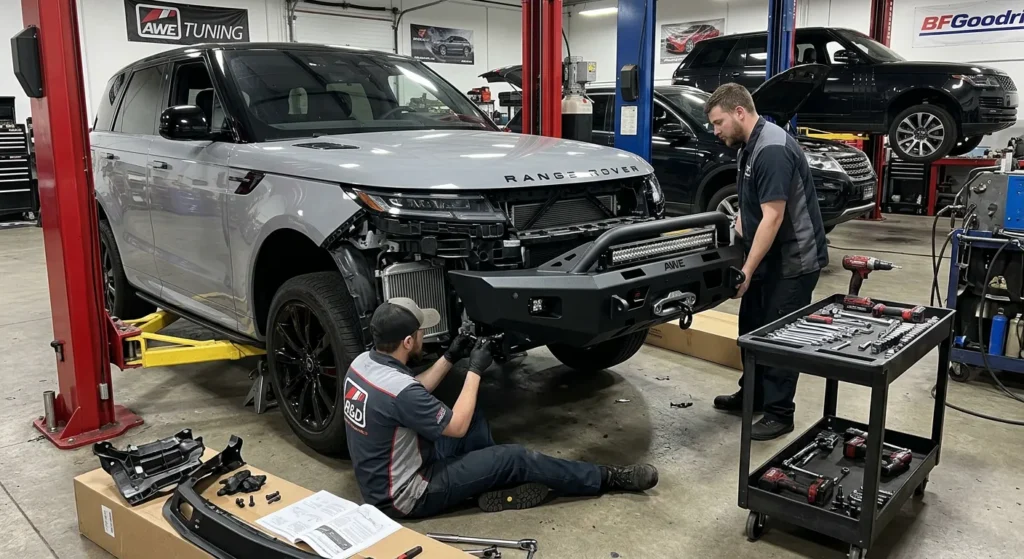
Do not assume the factory lights transfer because the aftermarket bumper has openings in roughly the same location.
Newer trucks and Jeeps can have electronic equipment integrated into the bumper area.
Possible equipment includes:
WARN lists factory parking sensors, blind-spot monitoring, and automatic cruise-control compatibility on selected current bumper applications.
Compatibility is vehicle and bumper dependent.
A bumper being compatible with parking sensors does not automatically mean it works with every camera or radar system on every trim.
Check the exact application.
Sensor position and orientation can matter.
If the bumper manufacturer supplies sensor brackets or relocation hardware, follow its instructions.
An aftermarket bumper can weigh more than the factory bumper it replaces.
Add a winch and the front of the vehicle may gain even more weight.
That added mass sits ahead of the suspension.
Depending on the vehicle and equipment, you may notice changes in:
This deserves extra attention when a heavy bumper, winch, larger tires, and other accessories are being installed together.
If the front already sags or the suspension has worn components, inspect it before adding more weight.
Notorious Auto Protection also provides suspension repair and truck lift and suspension kit installation.
Plan the bumper around the whole truck.
Bumper design can affect tire clearance.
This is most noticeable at the front corners when larger tires are installed.
During steering, a large tire can move toward:
WARN states that its Ascent bumpers accommodate oversized tires on listed applications.
That does not mean any tire size will fit simply because that bumper is installed.
Tire fitment still depends on:
If larger tires are part of the build, discuss them before selecting the bumper.
Notorious Auto Protection provides off-road wheel and tire services for lifted and modified trucks.
Jeep Wrangler and Gladiator owners have many bumper choices because these vehicles are frequently modified for trail use.
Possible configurations include:
Mopar’s Rubicon steel front bumper is a useful reference for how Jeep-specific systems can be designed.
Mopar describes its current catalog version as steel-reinforced and winch-capable, with removable ends that allow a high-clearance, narrow configuration. It also incorporates factory-style equipment such as fog lights in applicable versions.
WARN also produces Jeep-specific winch mounting plates for Wrangler generations including JL, JK, TJ, and CJ.
Jeep generation matters.
A bumper or winch plate for a JK should not be treated as a JL part simply because both vehicles are Wranglers.
Pickup owners have just as many decisions.
Aftermarket bumpers are available for many Ford, Chevrolet, GMC, Ram, Toyota, and other trucks.
Common choices include:
WARN’s current Ascent line includes vehicle-specific designs for late-model Ford, Chevrolet/GMC, Ram, and Toyota trucks.
Vehicle-specific design matters because mounting points and factory equipment vary.
A 2026 F-250 and a 2026 F-150 are both Ford trucks, but their bumper systems, dimensions, weight, and equipment are different.
Shop for the exact vehicle.
You will often see aftermarket bumpers described as bolt-on.
That does not mean universal.
It generally means the bumper was designed to attach using the intended mounting arrangement without custom fabrication for the listed vehicle.
WARN lists certain Ascent bumpers as bolt-on designs with included hardware and no drilling required.
Other bumper systems may require:
WARN’s semi-hidden 4Runner winch installation is one manufacturer example where the installation is largely bolt-on but requires trimming the factory lower valance.
Read the instructions for the exact bumper before installation starts.
A grille guard and a replacement bumper are not necessarily the same thing.
A grille guard may attach to the vehicle while retaining much of the original bumper.
A replacement bumper removes or changes the factory bumper assembly.
Some aftermarket systems combine:
WARN also sells modular mounting systems that can add components such as grille guards and light bars around a winch carrier.
Decide what function you actually need.
If your goal is a winch mount, you may not need a full replacement bumper on every vehicle.
If your goal is changing clearance and bumper shape, a replacement bumper may make more sense.
A bumper project can become complicated when parts are purchased before the complete setup is checked.
Small model-year changes can affect sensors, brackets, bodywork, and mounting.
Verify the exact application.
Check for an integrated or compatible winch mounting system.
Confirm that the winch fits the bumper and mounting system.
Check parking sensors, cameras, radar, and other electronic equipment before removing the factory bumper.
A heavy bumper and winch can add a meaningful amount of weight to the front suspension.
Determine whether factory fog lights transfer or whether new lights are needed.
Use only points intended for recovery.
Large tires and aggressive wheel offsets can interact with the bumper corners during steering.
If your truck or Jeep will receive several modifications, plan them together.
A front-end build might include:
Each choice can affect another.
The bumper needs to fit the vehicle.
The winch needs to fit the bumper.
The bumper needs to provide suitable space for the tires.
Lighting needs mounting locations and wiring.
The suspension needs to account for the final vehicle setup.
Notorious Auto Protection provides related services including:
Planning the parts as a package can reduce fitment surprises.
Notorious Auto Protection provides Aftermarket Bumper Installation for Trucks & Jeeps at our Syracuse, NY shop.
You can find us at:
Notorious Auto Protection
6742 Pickard Dr
Syracuse, NY 13211
Before selecting a bumper, know what you want it to do.
If you want a winch, tell us the winch model or the capacity you are considering.
If you have larger tires, provide the tire and wheel specifications.
If the vehicle has cameras, parking sensors, or other bumper-mounted electronics, those features need to be considered too.
For an off-road build, ground clearance and approach angle may matter more than they would on a street-focused truck.
For a daily driver, factory equipment retention and ease of use may carry more weight.
The bumper should fit both the vehicle and the way you use it.
Aftermarket Bumper Installation for Trucks & Jeeps works best when the bumper is chosen around the complete vehicle.
Check exact fitment first.
Then look at winch compatibility, recovery points, lighting, sensors, tire clearance, bumper weight, and the installation method.
If you plan to add a winch or auxiliary lighting later, consider that before buying the bumper. Choosing a compatible bumper now can prevent replacing or modifying parts again later.
For aftermarket bumper installation in Syracuse, NY, call Notorious Auto Protection at (315) 552-4441.
You can also visit our contact page to schedule an appointment.
Our hours are Monday through Saturday from 8 AM to 6 PM and Sunday from 8 AM to 5:30 PM.
Aftermarket bumpers are usually designed for defined vehicle applications. Year, make, model, body configuration, trim, sensors, and other factory equipment can affect fitment. Choose a bumper listed for your exact vehicle rather than relying on similar dimensions.
You need a mounting system designed for the winch loads involved. Some aftermarket bumpers have integrated winch mounts, while other vehicles can use a separate winch mounting system. WARN’s current bumper and mounting catalogs show both approaches.
Some will. WARN lists sensor and camera retention on selected bumper applications, but compatibility varies by bumper and vehicle. Check every factory feature around the bumper before ordering the replacement.
It can. A replacement bumper can add weight compared with the factory setup, and a winch adds more. The effect depends on the weight difference and vehicle. Ride height and suspension condition should be considered when adding heavy front-end equipment.
Many off-road bumpers include dedicated lighting ports or tabs. WARN’s current Ascent bumpers include auxiliary-light ports on listed applications. Lights still need suitable wiring, switching, mounting, and consideration for where they will be used.
Some high-clearance bumpers create more space around the front corners and can work better with larger tires. WARN states that its Ascent designs accommodate oversized tires on listed vehicles. Tire clearance still depends on tire dimensions, wheel offset, lift height, steering, and suspension movement.
Notorious Auto Protection provides bumper installation at 6742 Pickard Dr, Syracuse, NY 13211. We also provide winch installation, truck lighting, off-road wheels and tires, and other truck modifications. Call (315) 552-4441 or visit our contact page to schedule an appointment.
Your vehicle is a significant investment, and ensuring its protection from the elements and everyday hazards is crucial to maintaining its value and appearance. In Syracuse, NY, where road conditions and weather can be unpredictable, combining STEK Paint Protection Film (PPF) and Window Tint offers the ultimate solution for safeguarding your car. At Notorious Auto Protection, we specialize in applying these premium products to provide your vehicle with maximum protection and enhanced aesthetics.
Product Brand: Auto Protection
Question about the service you're choosing, or simply ready to book? Contact us today to get started
Explore the many services we offer by clicking the boxes below