Can you put ceramic coating over PPF? Yes, many paint protection film systems can be topped with a compatible ceramic coating. The two products serve different purposes. Paint protection film, often called PPF or clear bra, creates a physical film over painted surfaces, while ceramic coating forms a thin protective layer over the surface beneath it. When the products are designed to work together and applied correctly, ceramic coating can be installed over PPF.
For vehicle owners in Syracuse, NY, this combination can make sense when you want physical paint protection from PPF along with the surface characteristics of a ceramic coating. The important part is understanding what each product does and what ceramic coating does not add to the film.
At Notorious Auto Protection, we install paint protection film and ceramic coating. We work with products from Ceramic Pro and XPEL, including protection systems intended for automotive paint and PPF applications.
Here is how stacking the two types of protection works.
Yes, provided the ceramic coating is suitable for the film being used.
This is not simply an aftermarket theory. Major PPF manufacturers offer products made for this type of layered protection.
XPEL states that its FUSION PLUS Premium ceramic coating can be applied to paint and paint protection film. XPEL describes the coating as adding hydrophobic properties that help repel water and contaminants.
Ceramic Pro takes a similar approach. Ceramic Pro offers paint protection film and ceramic coating systems that can be used as parts of a vehicle protection package.
The order of those layers matters.
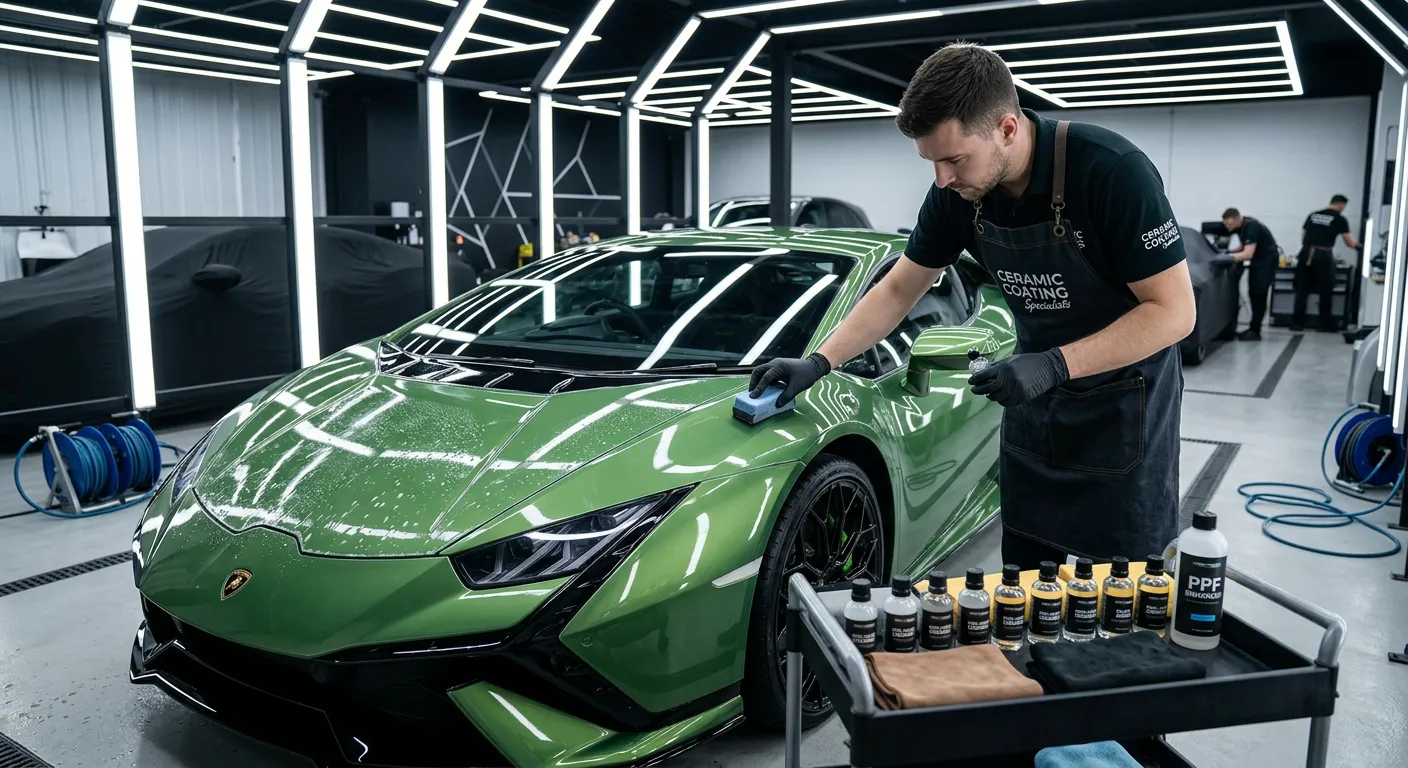
PPF is installed onto the prepared painted surface first. A compatible ceramic coating can then be applied over the film.
Think of the finished system as separate layers with separate jobs rather than one product replacing the other.
Paint protection film is a transparent or colored film installed over automotive surfaces.
Its physical construction is one of the main differences between PPF and ceramic coating.
XPEL describes its ULTIMATE PLUS paint protection film as a urethane film designed to protect vehicle paint from hazards such as rock chips, scratches, and road debris. The company also offers self-healing film technology in its ULTIMATE PLUS product family.
Ceramic Pro describes its KAVACA PPF as a film intended to protect automotive surfaces from road debris, scratches, environmental contaminants, and other sources of damage.
This physical film is why PPF is commonly installed on areas that receive frequent road exposure.
These can include:
A vehicle can also receive full-body PPF when the owner wants film coverage across most or all painted exterior panels.
Learn more about paint protection film installation at Notorious Auto Protection.
Ceramic coating performs a different job.
It is a liquid-applied coating that bonds with the surface and creates a thin protective layer.
Ceramic coatings are often associated with water behavior, easier maintenance, gloss, and resistance to certain environmental contaminants.
XPEL says its FUSION PLUS Premium coating creates a hydrophobic surface and can be applied over paint or PPF.
Ceramic Pro describes its ceramic coatings as protective layers for automotive surfaces that can provide hydrophobic behavior and resistance to contaminants.
That makes ceramic coating useful over PPF, but it does not turn ceramic coating into another layer of impact-absorbing film.
This distinction matters when deciding which product you need.
When you put ceramic coating over PPF, each layer has a separate role.
PPF sits over the paint and provides a sacrificial film between the painted surface and road exposure.
The film can help protect against:
Ceramic coating is applied over the film and changes the characteristics of the outer surface.
Depending on the selected product, this can provide:
Here’s what matters: ceramic coating over PPF does not make the two products interchangeable.
PPF remains the physical film.
Ceramic coating remains the coating applied over that film.
It is better to think of ceramic coating as adding surface properties rather than turning the PPF into a thicker impact barrier.
A ceramic coating does not replace the urethane structure of PPF.
If your main concern is physical damage from road debris, the PPF is doing that part of the job.
If your concern is water behavior, surface contamination, gloss, and easier upkeep, a compatible ceramic coating can add those characteristics over the film.
This is why comparing PPF and ceramic coating as competing products can be misleading.
They can address different concerns on the same vehicle.
There are several reasons a vehicle owner might choose to ceramic coat PPF.
Hydrophobic coatings cause water to behave differently on the treated surface.
XPEL lists hydrophobic properties among the features of FUSION PLUS Premium.
Water tends to form beads and move from a hydrophobic surface more readily than it would from an untreated surface.
Road grime, bugs, dust, and other contaminants still reach the outside of the vehicle.
PPF does not mean the vehicle stops getting dirty.
Adding a compatible ceramic coating can make routine cleaning of the coated surface easier.
The PPF itself becomes the exposed surface once installed.
Applying a coating designed for PPF places another thin layer over that film.
A compatible coating can add gloss to glossy PPF.
This can be useful when you want the protected panels to maintain a clean, glossy appearance.
PPF normally goes on first when both products are being installed on the same panel.
The film needs to adhere to a properly prepared surface.
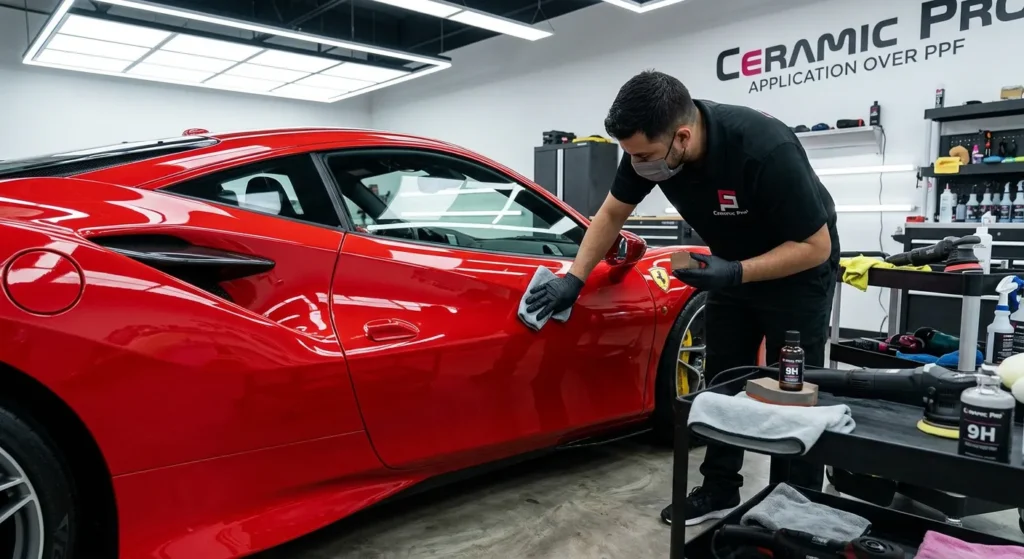
Once the PPF has been installed and the required installation steps have been completed, a compatible ceramic coating can be applied over it according to the product instructions.
Putting the ceramic coating underneath the PPF can create an unnecessary issue because the film adhesive needs the properly prepared surface specified by its manufacturer.
If you are planning to get both services, tell your installer before either job begins.
That allows the paint preparation, PPF installation, and coating application to be planned as one project.
Yes.
Your entire vehicle does not have to be covered with PPF before ceramic coating becomes an option.
Consider a vehicle with PPF installed on the front bumper, hood, front fenders, and mirrors.
Those areas have film over the paint.
The remaining painted panels do not.
A suitable ceramic coating can be selected for the appropriate exterior surfaces so the vehicle receives a more consistent approach to cleaning and exterior care.
The exact application process should follow the requirements of the coating and PPF manufacturers.
Yes, compatible ceramic coatings can be used over full-body PPF.
This gives the vehicle a physical film layer across the covered painted surfaces with a ceramic coating on top.
For owners who want extensive film coverage, this combination means the ceramic coating is protecting the exposed PPF surface rather than sitting directly on the original paint.
This is another reason the order of installation matters.
The protection stack looks like this:
Each layer serves a different purpose.
You do not need full-body PPF to combine PPF with ceramic coating.
Partial or front-end PPF packages are common because the front of a vehicle frequently receives direct road exposure.
A vehicle may have PPF protecting areas such as the hood, bumper, mirrors, and front fenders while the remaining panels retain exposed factory paint.
Ceramic coating can then be considered for both the compatible PPF surface and the remaining paint.
This approach can appeal to drivers who want physical film on high-exposure areas without wrapping every painted panel.
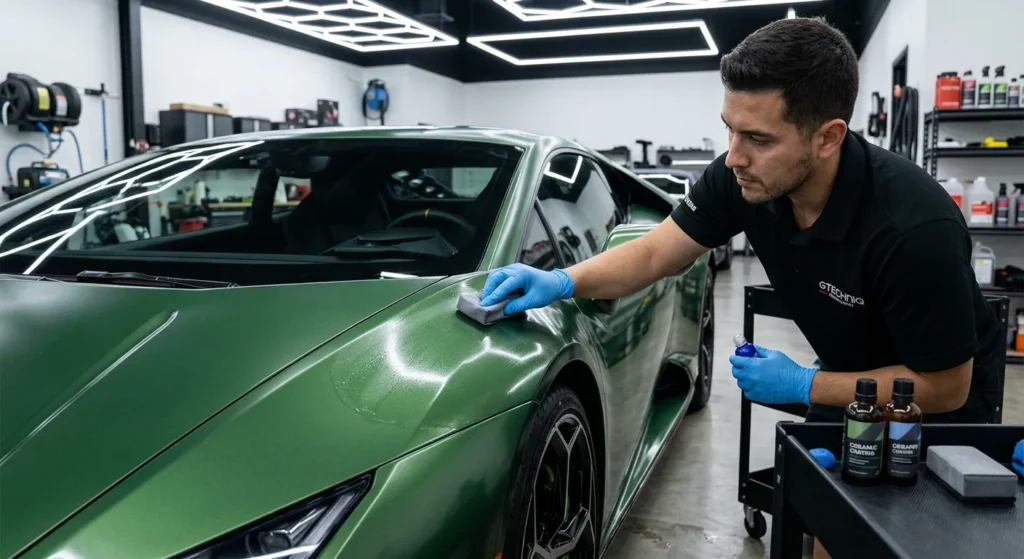
If you are considering this type of setup, ask Notorious Auto Protection about paint protection film and ceramic coating options for your vehicle.
A coating can be used with certain matte PPF products, but product compatibility matters.
You should not assume that every ceramic coating is suitable for every matte or satin film.
The appearance is one reason.
Matte PPF is selected because it creates a different finish from glossy film. Applying a product that alters that appearance could defeat the reason you selected matte PPF in the first place.
Use a coating that the manufacturer identifies as compatible with the specific film and finish.
Ceramic Pro and XPEL both offer multiple protection products, so the selected film and coating should be considered together rather than chosen separately.
Notorious Auto Protection also offers color paint protection film for drivers looking for options beyond traditional clear PPF.
Ceramic coating should not be treated as a substitute for PPF when rock-chip protection is the goal.
This is one of the biggest misconceptions surrounding ceramic coatings.
Ceramic coating creates a thin surface layer.
PPF is a physical urethane film.
XPEL describes ULTIMATE PLUS PPF as protection against hazards such as rock chips and road debris. That physical barrier is why PPF is used on areas where impact protection is desired.
If rock chips are your concern, look at paint protection film.
If you also want hydrophobic surface characteristics and easier maintenance, adding a compatible ceramic coating over the film can make sense.
The products are doing different jobs.
Some modern PPF products have surface treatments or top coats that provide hydrophobic characteristics.
This means the answer depends on the film.
Do not assume that every PPF needs an additional coating to repel water.
The better question is whether adding a ceramic coating gives you the surface behavior and maintenance characteristics you want from the specific film installed on your vehicle.
This is where product selection matters.
At Notorious Auto Protection, we work with XPEL and Ceramic Pro products, so we can discuss how the selected film and coating are intended to work together.
No. The self-healing characteristics of a PPF come from the film technology itself, not from applying ceramic coating over it.
XPEL identifies self-healing properties as a feature of its ULTIMATE PLUS PPF.
A ceramic coating applied on top has a different function.
It does not create the PPF’s underlying self-healing structure.
Keeping those roles separate makes it easier to understand what you are buying.
PPF characteristics come from the film.
Ceramic coating characteristics come from the coating.
When used together, you receive the properties provided by each compatible product.
The condition of the paint should be inspected before the protection is installed.
PPF and ceramic coating are not intended to repair existing paint defects.
If the vehicle has visible swirl marks, oxidation, scratches, or other correctable paint defects, paint correction may be considered before the protection process.
Whether correction is appropriate depends on the paint condition and the desired result.
This is especially worth discussing when protecting a used vehicle.
Once PPF is installed, the film covers the paint beneath it. Planning paint preparation before installation gives you the chance to address suitable defects first.
PPF and ceramic coating still require routine care.
Neither product makes a vehicle maintenance-free.
Follow the care instructions supplied for your specific film and coating.
General care may include:
XPEL publishes care information for its PPF and coating products, while Ceramic Pro provides maintenance guidance for its protection systems.
The exact instructions for your installed products should take priority over generic detailing advice.
If you prefer to have the exterior maintained professionally, Notorious Auto Protection also provides exterior detailing in Syracuse, NY.
The answer depends on what you want to protect against.
Start with your concerns.
If you want a physical film protecting painted surfaces from road debris and minor physical contact, PPF addresses that need.
If you want hydrophobic behavior, easier cleaning, and coating protection over the exposed surface, ceramic coating addresses a different need.
If you want both sets of characteristics, using compatible products together can make sense.
You do not need to treat it as an either-or decision.
The real question is which panels need PPF and which surfaces you want coated.
Vehicles in Syracuse, NY experience changing weather and road conditions throughout the year.
Owners who care about maintaining their paint may want to consider protection based on how and where the vehicle is driven.
A daily-driven vehicle may have different needs from a weekend sports car.
A new vehicle may have different paint preparation needs from a used vehicle.
A truck driven throughout the year may call for a different coverage plan from a car that spends much of the winter stored indoors.
This is why PPF coverage can be selected around the vehicle rather than assuming every owner needs the same setup.
Notorious Auto Protection provides both paint protection film and ceramic coating in Syracuse, NY.
We are Ceramic Pro certified and work with Ceramic Pro and XPEL protection products.
So, can you put ceramic coating over PPF?
Yes, when the coating and film are compatible and the products are installed in the proper order.
PPF provides the physical film layer.
Ceramic coating goes over the compatible film and adds its own surface characteristics.
You can use this approach with selected PPF-covered panels or a vehicle protected with full-body film.
Before scheduling the work, decide which parts of the vehicle receive the most road exposure and what you expect from the finished protection system.
Notorious Auto Protection can review your vehicle and discuss PPF, ceramic coating, and paint correction options.
Call (315) 552-4441 or visit our contact page to schedule an appointment in Syracuse, NY.
Yes. Compatible ceramic coatings can be applied over PPF. XPEL states that its FUSION PLUS Premium ceramic coating is suitable for paint and PPF. Always use products intended for the specific film and follow the manufacturer’s application requirements.
When both are being installed on the same panel, PPF is normally installed on the prepared painted surface first. A compatible ceramic coating can then be applied over the PPF according to the product instructions.
Ceramic coating should not be relied on as an impact barrier against rock chips. PPF is the physical film designed to provide protection against road debris and similar hazards. Ceramic coating adds different surface characteristics over the film.
Yes. A compatible ceramic coating can be applied over full-body PPF. In that setup, the PPF covers the painted panels and the ceramic coating becomes the outer treated surface.
Certain coatings can be used with matte or satin PPF, but compatibility should be confirmed before application. The wrong product may affect the desired finish. Follow the film and coating manufacturers’ recommendations.
No. Self-healing behavior is a property of certain PPF products. Applying ceramic coating does not create the film’s self-healing construction. The coating and PPF continue to serve separate purposes.
Notorious Auto Protection installs paint protection film and ceramic coating in Syracuse, NY. We work with Ceramic Pro and XPEL products. Call (315) 552-4441 or use our contact page to schedule an appointment.
Your vehicle is a significant investment, and ensuring its protection from the elements and everyday hazards is crucial to maintaining its value and appearance. In Syracuse, NY, where road conditions and weather can be unpredictable, combining STEK Paint Protection Film (PPF) and Window Tint offers the ultimate solution for safeguarding your car. At Notorious Auto Protection, we specialize in applying these premium products to provide your vehicle with maximum protection and enhanced aesthetics.
Product Brand: Auto Protection
Question about the service you're choosing, or simply ready to book? Contact us today to get started
Explore the many services we offer by clicking the boxes below