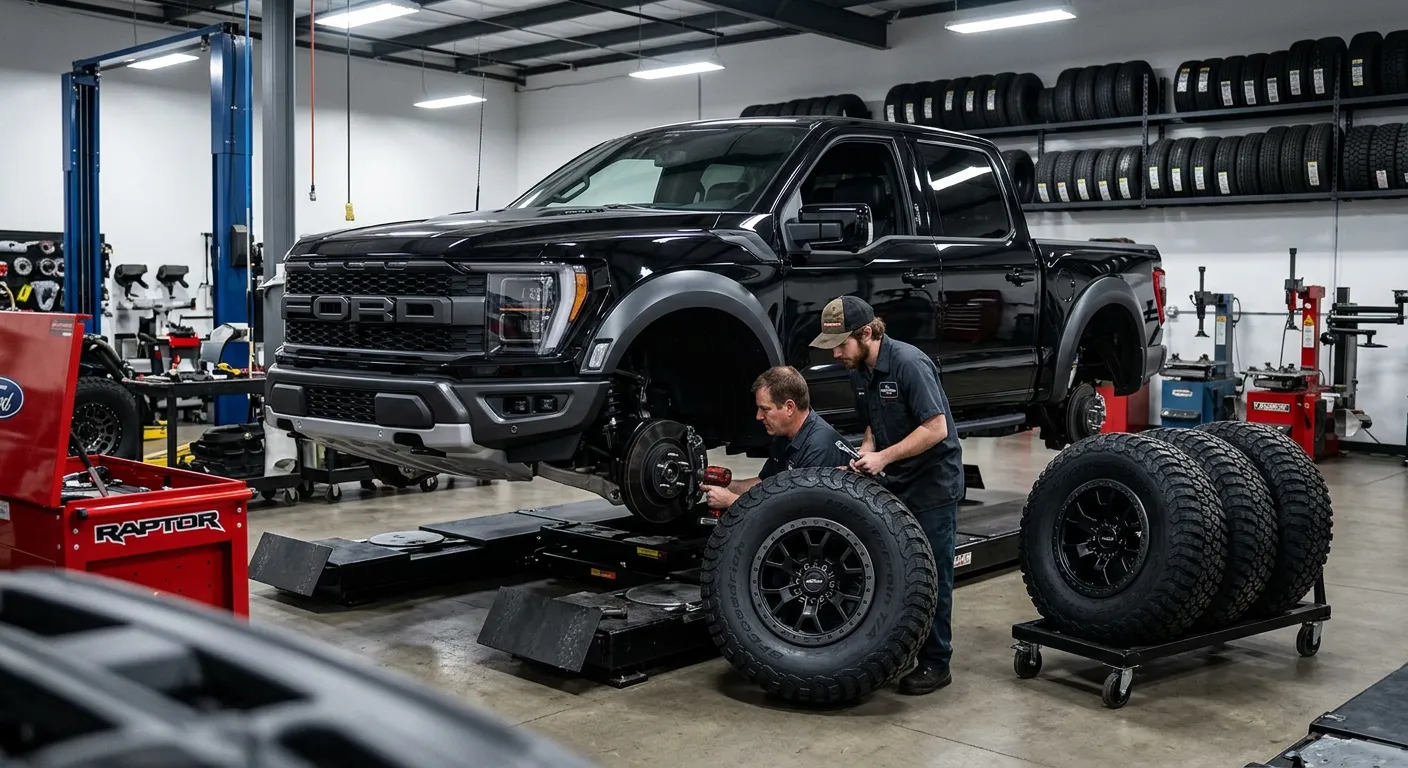
Off-Road Wheels & Tires in Central New York need to be sized around more than lift height. A suspension lift may create room for a larger tire, but tire diameter, width, wheel offset, wheel width, suspension travel, steering clearance, load capacity, and the truck’s intended use all affect the final fit.
A tire that clears while the truck is parked can still rub when you turn, brake, hit a bump, or compress the suspension. A wheel pushed too far outward can create a completely different clearance problem from one positioned closer to the suspension.
Then there is daily driving.
Larger off-road tires can add weight, change effective gearing, affect speedometer readings, and alter the way a truck accelerates, brakes, and steers. Tire construction and tread also influence how the truck behaves on pavement, snow, wet roads, mud, and trails.
Notorious Auto Protection provides off-road wheel and tire services along with truck lift and suspension kit installation in Syracuse, NY.
If you are building a lifted truck in Central New York, start with the complete setup rather than choosing a tire because another truck looks good on that size.
Lift height is one factor in tire clearance, but it does not give you a universal tire-size chart.
A three-inch lift on one truck does not guarantee the same tire clearance as a three-inch lift on another.
Factory wheel openings, suspension geometry, steering design, factory wheel offset, axle position, bumper shape, and lift-kit design differ.
Two trucks with the same lift height can need different wheel and tire combinations.
That is why statements such as “a three-inch lift fits 35s” need vehicle-specific context.
The better questions are:
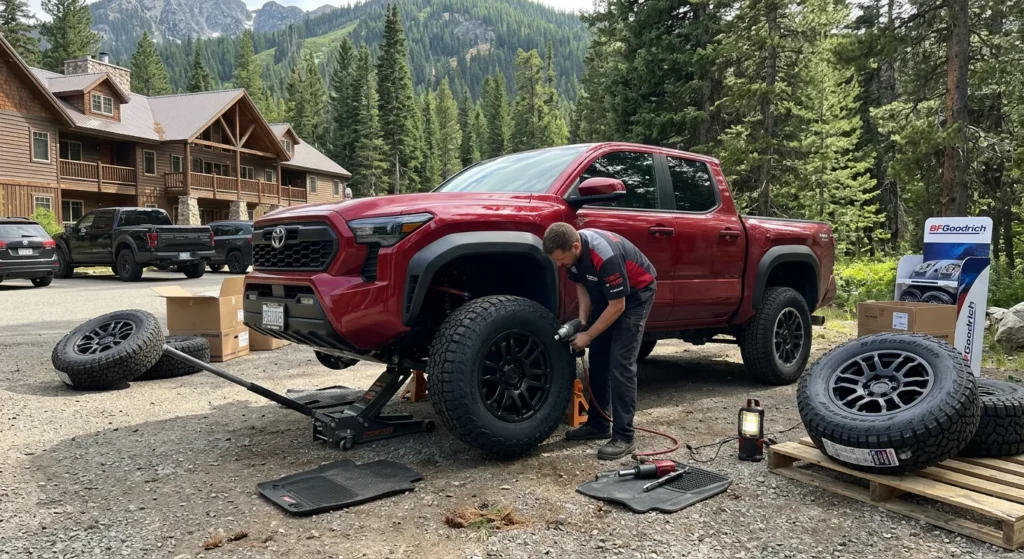
Those details tell you much more than lift height alone.
Before shopping for Off-Road Wheels & Tires in Central New York, identify the truck’s factory tire and wheel information.
NHTSA advises drivers to check the owner’s manual or Tire and Loading Information Label on the driver’s side door area for the vehicle manufacturer’s tire size and inflation information.
This establishes a reference point.
A lifted truck may move away from the factory tire dimensions, but you still need to know where the vehicle started.
Record:
From there, you can compare the proposed off-road setup with the original equipment.
Off-road truck tires commonly use either metric sizing or flotation sizing.
A metric tire may look like:
LT285/70R17
The numbers tell you several things.
LT identifies it as a light-truck tire designation.
285 refers to nominal section width in millimeters.
70 is the aspect ratio. The sidewall height is approximately 70 percent of the nominal section width.
R indicates radial construction.
17 is the wheel diameter in inches.
Off-road tires are also commonly sold in sizes such as:
35×12.50R17
This describes a tire with an approximate nominal overall diameter and width along with its wheel diameter.
Do not assume every tire carrying the same nominal size measures exactly the same.
Check the tire manufacturer’s published dimensions for the exact model and size.
The move from a stock tire to a 33, 35, or 37-inch off-road tire can change much more than appearance.
As diameter increases, consider:
Going from a 33 to a 35-inch tire may sound like a two-inch increase.
Remember that overall diameter is measured across the whole tire.
The radius changes by roughly half the diameter difference.
Real-world clearance still depends on actual tire dimensions and where the tire moves during steering and suspension travel.
The jump to a 37-inch tire can require far more planning than simply adding another inch of radius.
Diameter gets most of the attention, but width can be just as important for fitment.
A wider tire can move closer to:
Wheel offset changes where that width sits.
Moving the tire outward can create more clearance on the inside while reducing clearance at the outer fender or bumper area.
That is why “Will a 35 fit?” is not a complete sizing question.
A narrower 35-inch tire and a wide 35-inch tire can fit differently on the same truck.
Wheel diameter and tire diameter are not the same measurement.
You can have a 35-inch tire on several wheel diameters when suitable sizes exist.
A larger wheel leaves less tire sidewall when overall tire diameter remains similar.
A smaller wheel leaves more sidewall.
Off-road truck owners often value additional sidewall because it can provide more tire between the wheel and trail obstacles.
Wheel size can also affect:
Before reducing wheel diameter, make sure the wheel clears the truck’s brakes and other components.
Before increasing wheel diameter, think about how much sidewall you want for the truck’s intended use.
Every tire is designed to work within a specified range of wheel widths.
Check the tire manufacturer’s specifications before pairing a wheel and tire.
A wheel that is too narrow or too wide for the tire can change the tire’s shape and is outside the intended fitment.
Wheel width also affects clearance.
A wider wheel changes the position of the tire’s sidewalls and can increase the overall space required inside the wheel opening.
When comparing wheel packages, check:
A wheel fitting over the hub does not make it the correct wheel for the truck.
Wheel offset describes the position of the wheel mounting surface relative to the wheel’s centerline.
Offset is commonly measured in millimeters.
A wheel can have:
Changing offset moves the wheel and tire inward or outward relative to the suspension and body.
A more outward position can create the wider stance many lifted-truck owners want.
It can also change clearance.
Move the tire outward and you may gain space between the tire and an inner suspension component.
At the same time, the outer edge of the tire moves closer to the fender and other bodywork during steering.
Offset needs to be chosen with the entire tire package in mind.
Tire rubbing can occur in several places.
Common areas include:
Where rubbing occurs can change as the steering wheel turns.
That is why checking clearance with the wheels pointed straight ahead is not enough.
The tire needs room through its steering range and suspension movement.
Changing wheel offset may move the rubbing rather than eliminate it.
Too far inward can create suspension clearance issues.
Too far outward can increase contact near the fender or bumper.
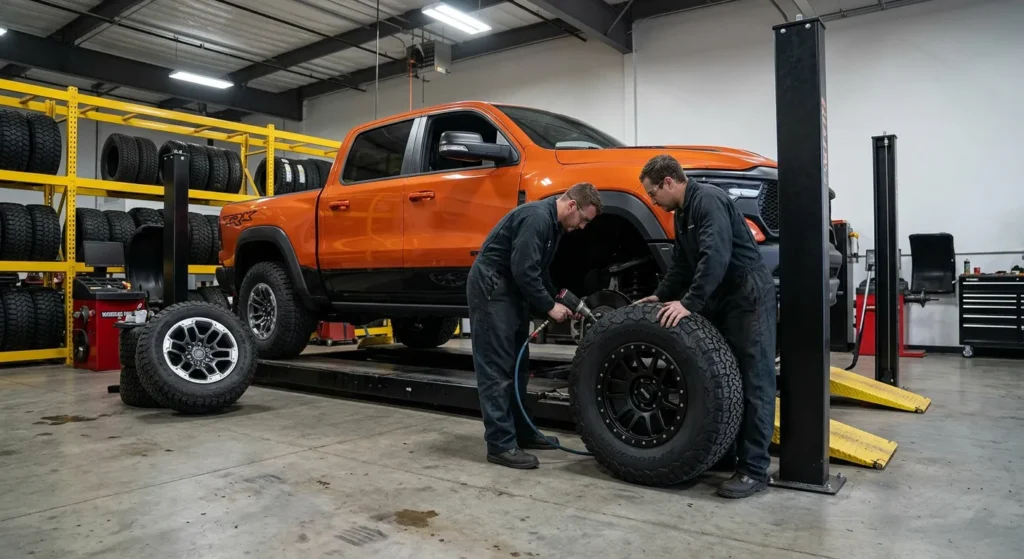
Fitment is about finding the right position for the tire, not simply pushing it outward.
A lifted truck’s suspension still moves.
The tire travels upward and downward relative to the body, and front tires also change position while steering.
This makes static clearance only the beginning of the fitment check.
Imagine a truck sitting in a parking lot with half an inch between the tire and part of the wheel opening.
It appears to fit.
Now compress the suspension while the steering wheel is turned.
That small gap may disappear.
Off-road driving makes this even more relevant because the suspension can move through much more of its available travel.
Choose tire clearance around how the truck moves, not just how it looks while parked.
Tire load capacity cannot be ignored when moving to an aftermarket size.
NHTSA states that replacement tires should have at least an equal maximum load rating to the original tires in its tire guidance and interpretations.
Michelin also advises that a replacement tire should have equivalent or greater load capacity than the specification for the vehicle.
Light-truck tires may carry load-range markings such as C, D, E, or other ratings depending on the tire.
Do not choose based on the load-range letter alone.
Check the actual load index and load capacity for the exact tire size.
BFGoodrich’s current All-Terrain T/A KO3 range illustrates this point. Depending on size, KO3 tires are offered with different load ranges and load indexes.
A 35-inch tire is not automatically rated to carry more than every smaller tire.
Read the specification for the exact tire.
Tread design should match how the truck is used.
NHTSA describes all-terrain tires as a compromise between on-road driving and off-road capability.
That makes an all-terrain tire worth considering for a truck that spends most of its time on pavement but still travels on dirt, gravel, trails, or similar surfaces.
Mud-terrain tires use more aggressive tread designs aimed toward off-road conditions.
That appearance can be appealing, but ask how much time the truck actually spends away from pavement.
A Central New York daily driver may need to handle:
Choose the tire around those conditions rather than selecting the most aggressive tread available simply because the truck is lifted.
Central New York winter driving deserves its own discussion.
NHTSA states that winter tires are more effective than all-season tires in deep snow. The agency also describes all-terrain tires as a compromise between road use and off-road capability.
An aggressive-looking off-road tread is not automatically the same as a dedicated winter tire.
Look at the tire’s intended use and manufacturer markings.
Some all-terrain tires carry the Three-Peak Mountain Snowflake symbol, commonly called 3PMSF.
That marking can be useful when comparing tires intended for severe snow service, but it still does not make every tire behave identically on ice, packed snow, slush, and dry pavement.
Central New York truck owners should think about the full year, not just summer trails.
Increasing tire diameter changes the effective gearing of the truck.
A larger tire travels farther with each revolution.
That means the engine and drivetrain do not operate exactly as they did with the smaller factory tire.
Drivers may notice changes in:
The amount of change depends on the difference between the old and new tire diameters and the truck’s axle gearing.
A mild tire-size increase may be less noticeable than a large jump.
Trucks moving to much larger tires may need additional planning beyond the suspension lift itself.
Tire diameter can affect speedometer and odometer readings.
Tire Rack notes that changing overall tire diameter can alter speedometer accuracy and may affect systems that depend on wheel-speed information.
The basic reason is straightforward.
The truck estimates distance and speed using a tire circumference expected by its systems.
Install a tire with a substantially different circumference and the vehicle travels a different distance per tire revolution.
Some trucks can be recalibrated for a different tire size.
Whether that is possible and how it should be performed depends on the vehicle.
Do not assume the speedometer remains accurate after a major tire-size change.
Larger off-road wheels and tires can add rotating and unsprung mass.
Tire Rack notes that maximum plus-size wheel and tire packages on trucks and SUVs can become considerably heavier than original equipment and may contribute to longer stopping distances along with added suspension and brake wear.
The effect varies with the actual wheel and tire package.
A 35-inch tire does not have one universal weight.
Neither does an aftermarket wheel.
Compare actual specifications when possible.
If your lifted-truck project involves a large jump in tire size and weight, braking behavior belongs in the conversation.
Notorious Auto Protection also provides brake repair and suspension repair for related vehicle concerns.
Suspension changes can alter wheel alignment.
The exact adjustment procedure depends on the truck and lift system.
Alignment should be checked after suspension work when called for by the kit and vehicle procedures.
This becomes even more relevant when new wheels and tires are installed at the same time.
NHTSA notes that proper wheel alignment helps prevent a vehicle from veering and helps extend tire life.
Watch new off-road tires after installation.
Irregular wear can be an early clue that something needs attention.
Check for:
A large off-road tire can be expensive to replace early because an alignment or suspension concern was ignored.
Do not automatically use the maximum pressure printed on the tire sidewall as your everyday inflation setting.
NHTSA tells drivers that the correct factory tire pressure is listed on the vehicle’s Tire and Loading Information Label or in the owner’s manual, rather than simply using the maximum figure on the tire.
Once a truck has moved to a substantially different tire size, construction, or load rating, determining a suitable inflation pressure can require more information.
The tire’s load-inflation requirements and vehicle loading need to be considered.
Do not assume an E-load-range tire should always be inflated to the maximum pressure molded on its sidewall.
The tire needs enough pressure for the load it carries without treating the sidewall maximum as an automatic daily setting.
Many newer trucks use a Tire Pressure Monitoring System.
NHTSA states that passenger cars, light trucks, and vans from model year 2008 onward are equipped with TPMS under federal requirements.
Changing wheels means the TPMS equipment needs to be considered.
Depending on the truck and wheel package, installation may involve:
A wheel package should be checked for TPMS compatibility before the tires are mounted.
The goal is to avoid discovering after installation that the new wheel design creates a sensor or fitment problem.
Once tire size has been narrowed down, choose the wheel around that tire and truck.
Check:
Appearance comes after those measurements.
A wheel can have the correct bolt pattern and still be wrong for the truck.
Wrong offset can create rubbing.
Wrong width can fall outside the tire manufacturer’s approved range.
Insufficient load capacity can make the wheel unsuitable for the vehicle.
Brake clearance can also become an issue with certain wheel designs.
Fit the wheel, tire, suspension, and truck together.
Many fitment problems begin with buying parts separately.
Lift height does not determine tire fitment by itself.
Truck design, tire width, wheel offset, suspension travel, and other dimensions still matter.
Nominal sizes do not tell you every physical dimension.
Check the manufacturer’s specifications.
An aggressive outward stance can create new fender and bumper clearance problems.
The tire and wheel need suitable load ratings for the truck.
A larger tire may not fit the factory spare location.
Think about where a matching spare will go before you need one.
Large LT tires and off-road wheels can be much heavier than factory equipment.
Turn the steering and account for suspension movement.
A truck that spends most of its life on Syracuse roads has different needs from one built mainly for off-road use.
If you have not lifted the truck yet, planning the suspension and wheel package at the same time can reduce guesswork.
Notorious Auto Protection offers:
Start with the final result you want.
Then work backward through tire diameter, tire width, wheel dimensions, offset, lift height, and clearance.
That makes more sense than buying 35s first and trying to build the rest of the truck around them afterward.
Notorious Auto Protection provides off-road wheel and tire services for truck owners in Syracuse, NY and Central New York.
Our shop is located at:
Notorious Auto Protection
6742 Pickard Dr
Syracuse, NY 13211
If your truck is already lifted, bring the details of the suspension setup when discussing new wheels and tires.
If the lift has not been installed yet, planning the lift and tire package together can make it easier to choose compatible parts.
Think about how you actually use the truck.
A daily-driven pickup that sees Central New York winters and occasional trails may call for a different tire than a truck built around frequent mud and off-road driving.
The right setup should work when the truck is moving, turning, carrying weight, and traveling through suspension movement, not just when it is sitting in a parking lot.
Off-Road Wheels & Tires in Central New York should be selected as part of the truck’s complete setup.
Lift height creates additional space, but it does not determine tire size on its own.
Tire diameter affects clearance and gearing.
Tire width and wheel offset determine where the tire sits.
Wheel width needs to match the tire.
Load ratings need to remain suitable for the truck.
Suspension movement and steering need enough clearance for the tire to move without unwanted contact.
For off-road wheels and tires in Syracuse, NY, call Notorious Auto Protection at (315) 552-4441.
You can also use our contact page to schedule an appointment.
Our hours are Monday through Saturday from 8 AM to 6 PM and Sunday from 8 AM to 5:30 PM.
There is no universal tire size for a given lift height. Fitment depends on the truck, lift system, wheel width, offset, tire width, body clearance, steering movement, and suspension travel. Check the complete setup before ordering tires.
Some truck and lift combinations may accommodate a nominal 35-inch tire, while others may rub or require different wheel specifications or additional changes. The exact truck, tire dimensions, wheel width, and offset need to be checked. Lift height alone cannot answer the question.
Yes. Offset changes where the wheel and tire sit relative to the suspension and body. Moving the tire outward can increase clearance in one area while reducing clearance near the fender or bumper. Offset should be chosen with tire width and vehicle-specific clearance in mind.
They can. Tire Rack notes that changes in overall tire diameter can affect speedometer accuracy and other speed-dependent vehicle systems. A larger tire travels farther per revolution. Some vehicles can be recalibrated for the new tire size.
All-terrain tires are intended to balance road and off-road use, according to NHTSA. Some carry severe-snow markings. A dedicated winter tire is still a separate category, and NHTSA states that winter tires are more effective than all-season tires in deep snow. Check the exact tire’s winter ratings and intended use rather than judging it by tread appearance.
Suspension changes can alter alignment, so alignment should be checked according to the lift-kit and vehicle procedures. Proper alignment also helps control irregular tire wear. This matters even more when fitting larger off-road tires.
Notorious Auto Protection provides off-road wheel and tire services at 6742 Pickard Dr, Syracuse, NY 13211. We also provide truck lift and suspension kit installation, truck wheels and tires, and other truck modifications. Call (315) 552-4441 or use our contact page to schedule an appointment.

Your vehicle is a significant investment, and ensuring its protection from the elements and everyday hazards is crucial to maintaining its value and appearance. In Syracuse, NY, where road conditions and weather can be unpredictable, combining STEK Paint Protection Film (PPF) and Window Tint offers the ultimate solution for safeguarding your car. At Notorious Auto Protection, we specialize in applying these premium products to provide your vehicle with maximum protection and enhanced aesthetics.
Product Brand: Auto Protection
Question about the service you're choosing, or simply ready to book? Contact us today to get started
Explore the many services we offer by clicking the boxes below