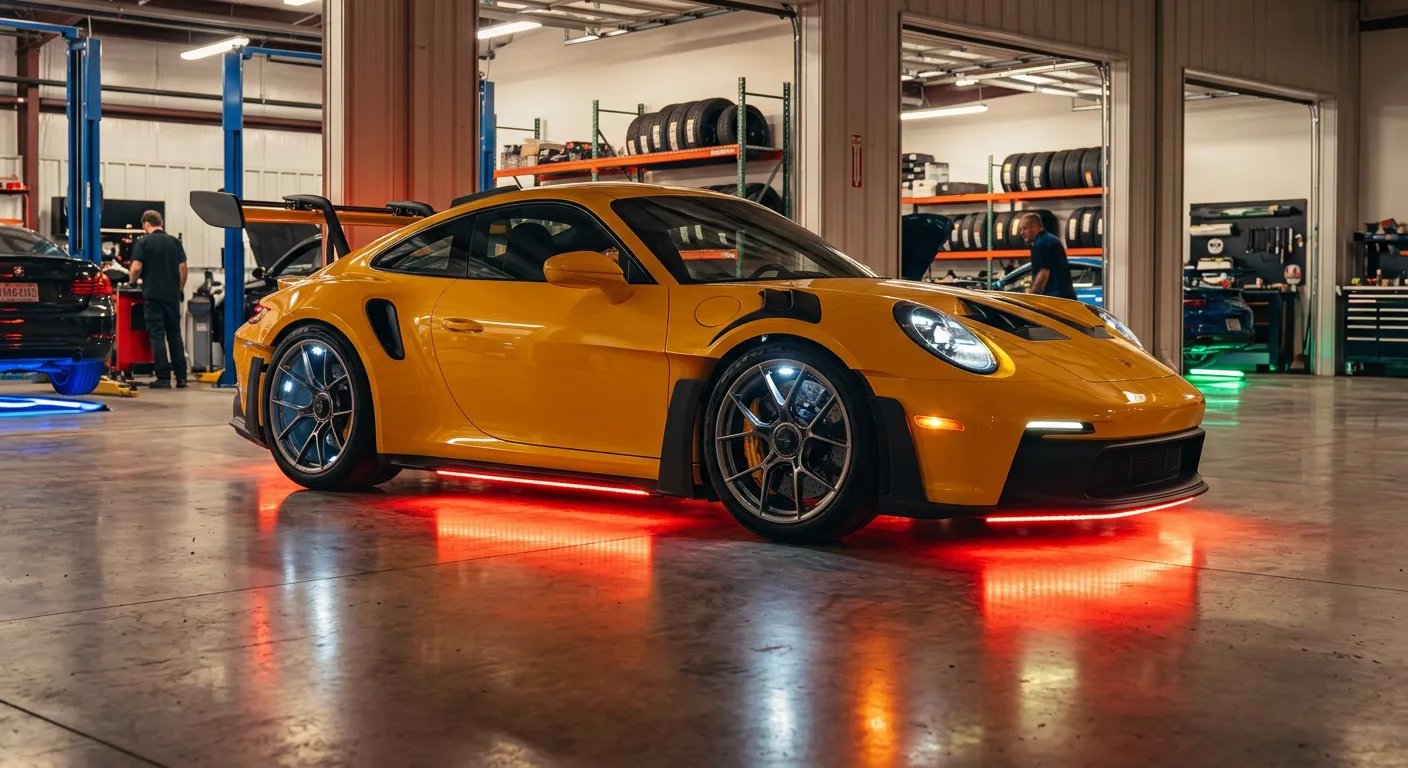
Rock Lights vs Underglow comes down to purpose, mounting location, and the type of light you want around your vehicle. Rock lights are usually compact LED pods mounted in wheel wells or underneath a truck, Jeep, SUV, or off-road vehicle. They can illuminate the ground around the tires, helping with visibility on trails and uneven terrain. Underglow is usually installed to create a more continuous glow beneath the vehicle, with appearance being the main goal.
The two styles can look similar at night. Their designs can be very different.
Rock lights commonly use individual sealed pods aimed toward selected areas. Underglow kits may use LED strips, tubes, bars, or other fixtures positioned around the underside of a vehicle. RGB versions of either system can add color control, brightness adjustment, and lighting effects.
Notorious Auto Protection provides rock light installation and vehicle underglow installation in Syracuse, NY.
Before deciding which lighting setup fits your vehicle, think about whether you want trail visibility, accent lighting, or a mix of both.
Rock lights are compact lights installed around the underside or wheel-well areas of a vehicle.
Rough Country describes rock lights as small LED fixtures usually mounted in the wheel wells or along the frame. Their downward-facing light illuminates areas near the tires that the headlights may not reach.
ORACLE Lighting describes a similar purpose for its rock-light systems. Its wheel-well kits are designed to illuminate the ground around the tires during off-road use.
That can help when traveling slowly across:
Placement matters because the goal is to put light where the person operating the vehicle needs it.
Rock lights can also create an accent-light appearance.
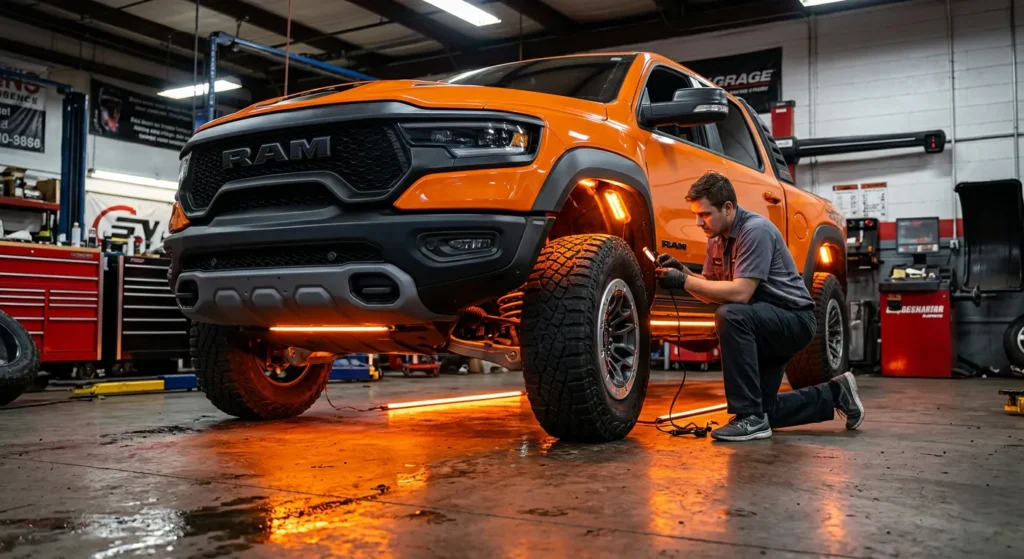
RGB rock lights make that visual side even more noticeable.
Underglow focuses on illuminating the ground beneath the vehicle.
Rather than concentrating light around individual tires, an underglow system is commonly arranged to spread light across larger portions of the vehicle’s underside.
Depending on the kit, underglow may use:
The result is a pool or outline of light beneath the vehicle.
Underglow is commonly chosen for appearance rather than trail visibility.
A car owner might want the light to follow the rocker areas and front or rear portions of the car.
A truck owner may want a similar effect across the frame and underside.
The exact appearance depends on where the lights are positioned and whether the fixtures themselves remain hidden from normal viewing angles.
The biggest Rock Lights vs Underglow differences are purpose and light placement.
Rock lights commonly:
Underglow commonly:
There is some overlap.
A group of rock-light pods positioned across the underside can create an underglow appearance.
That does not change the physical design of the lights.
Rock-light placement depends on the vehicle and desired coverage.
ORACLE recommends wheel-well placement in front of and behind the tires with certain kits when broad obstacle visibility is wanted.
Other possible mounting areas include:
The lights should be positioned so the beam reaches the intended area.
They also need protection from:
A lifted truck may expose more of the underside, which can make light placement particularly noticeable.
Think about where the beam lands before drilling mounting holes.
Underglow is normally positioned along the underside of the vehicle where the lights can cast onto the pavement without making the fixtures the visual focus.
Possible locations include:
The goal is usually even light distribution.
If one fixture is positioned much closer to the ground than another, you may see bright and dark spots instead of a consistent glow.
Vehicle shape matters.
A low car, lifted truck, Jeep, and SUV all have different distances between the body and ground.
That changes how the light spreads.
Trail visibility is where rock lights separate themselves from appearance-focused underglow.
Rough Country states that rock lights illuminate areas around the tires that headlights cannot reach.
ORACLE makes the same general case for its off-road rock-light systems, describing wheel-well placement as a way to see tire placement and obstacles.
Imagine moving slowly across uneven terrain at night.
Your headlights illuminate the area ahead.
They may not show exactly what is next to the front or rear tires.
A properly positioned white rock light can illuminate those areas.
That can help when a spotter or vehicle operator needs to see:
Rock lights do not replace headlights or careful off-road spotting.
They add light around parts of the vehicle that forward-facing lamps may miss.
Underglow has a different focus.
The goal is usually to create visible light beneath the vehicle.
RGB systems can let the owner select different colors.
Some systems also offer:
Those features are mainly visual.
Remember that having a lighting effect available in an app or controller does not mean that effect is permitted while the vehicle is being operated on a New York public road.
Street use and parked show use should be treated separately.
White rock lights are a straightforward choice when visibility is the main goal.
ORACLE sells white rock-light systems designed to illuminate the ground around the vehicle.
RGB systems give owners color choices.
Some RGB systems also include a dedicated white LED rather than creating white by mixing red, green, and blue.
ORACLE’s current ColorSHIFT RGB+W kit uses separate white output along with RGB color control.
That gives one system two possible roles.
White can be used when useful ground illumination is wanted in an appropriate setting.
Color modes can create an accent-light effect while the vehicle is parked or being used where those colors are permitted.
RGB stands for red, green, and blue.
By changing the output of those colors, a controller can create many other colors.
RGB+W systems add a separate white channel.
Depending on the kit, controls can include:
ORACLE’s current RGB+W rock-light system offers Bluetooth smartphone control and a wireless remote. Its controller can change colors and brightness and access lighting patterns.
That level of control can make a rock-light system look similar to traditional underglow when used as accent lighting.
The mounting style remains different.
There is no single correct number of rock lights for every vehicle.
A four-pod system can place one light around each wheel area.
An eight-pod system allows more coverage.
Large trucks may need different placement from smaller Jeeps.
The beam angle matters too.
ORACLE’s current RGB+W system uses a 230-degree beam and is sold in four- and eight-piece configurations. The manufacturer says the wide beam can reduce the need for multiple pods in one wheel well.
A narrower beam may require more lights to fill the same area.
Before deciding how many pods you want, consider:
More pods are not automatically better if the placement creates glare or unnecessary overlap.
Anything mounted underneath a vehicle lives in a harsh location.
Rock lights and underglow can encounter:
That is particularly relevant in Syracuse, NY and Central New York winters.
Look at the manufacturer’s ingress-protection rating when comparing light fixtures.
ORACLE’s current ColorSHIFT rock-light systems use IP68-rated light pods and waterproof connections.
An IP rating applies to the product as tested and described by its manufacturer.
The rest of the installation still matters.
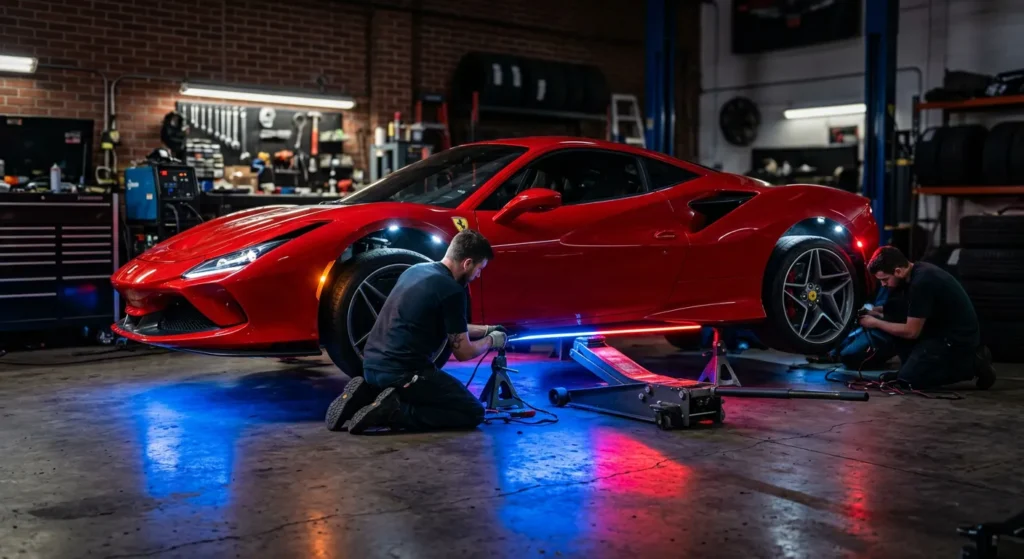
Connections, wire routing, control modules, switches, and other electrical components need suitable placement.
Good lighting installation is about more than attaching LED fixtures.
The wiring needs a safe route from the lights to the power and control equipment.
Depending on the system, installation can involve:
ORACLE’s current RGB+W kit includes battery leads with ring terminals, an inline fuse, waterproof connectors, a control module, and an on/off switch.
Wire routing matters underneath a vehicle.
Wiring should stay away from:
Loose wiring hanging under a truck can become damaged during road or trail use.
A simple single-color rock-light setup may use an on/off switch.
RGB systems often add a controller.
Smartphone-controlled lighting can make it easier to change:
A physical switch can still be useful.
ORACLE’s RGB+W system includes both electronic control and a pre-wired on/off switch.
Think about how you want to use the lights.
For off-road visibility, quick access to white lighting may matter more than scrolling through color choices.
For a parked show vehicle, app-based color control may be more appealing.
Lifted trucks are a natural match for rock lights.
The added ride height exposes more of the underside and creates more distance between the truck and the ground.
Well-positioned lights can illuminate:
Rock lights can be planned alongside other truck changes.
Notorious Auto Protection offers:
If the truck is being lifted soon, consider waiting until the suspension and tire setup is known before finalizing light placement.
That lets the lights be positioned around the finished truck.
Jeep Wrangler and Gladiator owners often use rock lights for trail illumination and appearance.
Wheel-well placement can put light around each tire.
Additional pods along the underside can illuminate the center area.
Before mounting lights on a Jeep used off road, consider where suspension components move during articulation.
A wire that looks safely positioned while the Jeep sits on level pavement may be too close to a moving component when one wheel is pushed upward.
Check:
The lights themselves should also be positioned where rocks and debris are less likely to hit them directly.
A car owner may have little need for off-road tire illumination.
That makes appearance-focused underglow a more natural choice.
An underglow system can create light beneath:
The lights are usually positioned so you see the glow rather than staring directly at the LED fixtures.
Lower vehicles can create a concentrated glow because the light source sits closer to the pavement.
Cars also have less underbody clearance for mounting.
Exhaust routing, splash shields, jack points, and other equipment need to remain accessible.
Yes, depending on what you want the final setup to look like.
Rock-light pods can be mounted in positions that illuminate the underside rather than only the wheel wells.
ORACLE itself describes its rock-light systems as both wheel-well and underbody lighting.
Multiple wide-angle pods can create broad pools of light beneath a vehicle.
There is still a visual difference between individual pods and long LED strips.
Pods tend to create concentrated zones of light.
A strip-style underglow system can produce a more continuous line along the vehicle.
The choice depends on the appearance you want and whether you also need off-road illumination.
New York vehicle-lighting rules deserve attention before installing colored exterior lighting.
New York Vehicle and Traffic Law Section 375 governs vehicle equipment and lighting.
Subdivision 41 covers colored and flashing lights that are not otherwise required by law.
The current law states that no light other than white light may be affixed to or displayed on a vehicle unless permitted by the exceptions in that subdivision.
It also restricts revolving, rotating, flashing, oscillating, or constantly moving white lights.
Separate provisions allow certain red, amber, blue, and green lights on defined emergency, hazard, volunteer fire, volunteer ambulance, and other authorized vehicles under stated conditions.
For an ordinary passenger vehicle, truck, SUV, or Jeep used on New York public roads, this makes colored rock lights and colored underglow a street-use concern.
The fact that an RGB controller offers red, blue, green, flashing, or color-changing modes does not mean those modes can be displayed legally on public roads in New York.
If you want colored lighting mainly for shows, private property, or off-road use, keep public-road restrictions in mind when choosing controls and wiring.
New York law can change, so check the current state rules before using aftermarket exterior lighting on a public street.
White is treated differently from colored lighting under Section 375 subdivision 41, but that does not mean every white aftermarket lighting setup can be used in every manner.
New York’s equipment law contains other requirements governing lamps, glare, headlamps, and vehicle lighting.
Section 375 states that lamps used on a motor vehicle must be arranged, adjusted, and operated to avoid dangerous glare or dazzle.
The safest approach is to separate trail or show lighting from required road lighting.
Rock lights should not be treated as substitutes for legal headlights, taillights, turn signals, or other required lamps.
Wheel-well lights need clearance from tires and moving suspension parts.
Check the vehicle through steering and suspension movement.
Exhaust components can become very hot.
Keep electrical wiring away from them.
Underbody connections encounter water, dirt, and road residue.
Use the system’s weather-resistant connections as intended.
Rock lights intended for trail visibility need to illuminate useful ground areas.
A bright pod aimed sideways may create glare without helping tire placement.
A long truck may show large dark gaps if the lights are spaced too far apart.
Extra pods can create overlapping hot spots.
Plan coverage before mounting.
RGB kits can offer colors and flashing patterns that are restricted on public roads.
Installation capability and legal street display are separate questions.
Choose around what you want the lights to do.
Rock lights make sense when you want light around the tires or ground beneath an off-road vehicle.
They work especially well with:
Underglow makes sense when your goal is a more continuous accent-light appearance beneath a car, truck, or SUV.
RGB rock lights can blur the line between the two.
A well-positioned RGB rock-light kit can provide wheel-well illumination and create an underbody glow while parked.
If you want both functions, pod placement becomes even more important.
Notorious Auto Protection provides both rock light installation and vehicle underglow installation in Syracuse, NY.
Our shop is located at:
Notorious Auto Protection
6742 Pickard Dr
Syracuse, NY 13211
Tell us how you plan to use the lights.
If you have a lifted truck or Jeep that sees trails, rock-light placement can focus on wheel and ground visibility.
If you have a street car and want accent lighting for parked display, an underglow setup may fit the look you have in mind.
We also provide related services including:
Planning the lighting with the rest of the vehicle can make mounting and wiring cleaner.
Rock Lights vs Underglow becomes easier to understand once you decide whether function or appearance matters more.
Rock lights use compact pods that can illuminate the ground around the tires. That makes them useful on trucks, Jeeps, and off-road vehicles.
Underglow is usually aimed at creating a broader accent-light effect beneath the vehicle.
RGB rock lights can do some of both.
The installation still needs suitable mounting locations, weather-resistant electrical connections, protected wire routing, and controls that make sense for the vehicle.
New York’s restrictions on colored and flashing vehicle lights also need to be considered before using aftermarket lighting on public roads.
For rock light or underglow installation in Syracuse, NY, call Notorious Auto Protection at (315) 552-4441.
You can also use our contact page to schedule an appointment.
Our hours are Monday through Saturday from 8 AM to 6 PM and Sunday from 8 AM to 5:30 PM.
Rock lights usually use compact LED pods mounted around wheel wells or underneath a vehicle. They can illuminate the ground around the tires for off-road use. Underglow is usually arranged to create a broader accent-light effect beneath the vehicle.
No. Rock lights can also be installed for appearance. RGB systems can illuminate wheel wells and the underside of a vehicle in many colors. Their compact pod design makes them particularly useful for trucks, Jeeps, and SUVs where targeted ground illumination is wanted.
Yes. Multiple rock-light pods can be positioned along the underside to create an underglow effect. ORACLE sells rock-light systems for wheel-well and underbody use. Pods can create a different lighting pattern from continuous LED strips, so placement affects the final appearance.
It depends on the product. ORACLE’s current ColorSHIFT rock-light systems list IP68-rated pods and waterproof connections. Check the ingress-protection rating and manufacturer’s specifications for the exact kit rather than assuming every rock light is waterproof.
Four pods can provide one light around each wheel area, while eight or more can fill additional areas. Vehicle size, ride height, beam angle, and desired coverage all affect the number that makes sense. Placement matters as much as pod count.
New York Vehicle and Traffic Law Section 375 subdivision 41 restricts colored lights affixed to or displayed on vehicles unless an exception applies. It also sets rules for flashing and moving lights. RGB lighting modes that are available from the manufacturer should not automatically be treated as permitted for public-road use. Check current New York requirements before displaying aftermarket exterior lighting on public streets.
Notorious Auto Protection provides rock light installation and vehicle underglow installation at 6742 Pickard Dr, Syracuse, NY 13211. Call (315) 552-4441 or use our contact page to schedule an appointment.
Your vehicle is a significant investment, and ensuring its protection from the elements and everyday hazards is crucial to maintaining its value and appearance. In Syracuse, NY, where road conditions and weather can be unpredictable, combining STEK Paint Protection Film (PPF) and Window Tint offers the ultimate solution for safeguarding your car. At Notorious Auto Protection, we specialize in applying these premium products to provide your vehicle with maximum protection and enhanced aesthetics.
Product Brand: Auto Protection
Question about the service you're choosing, or simply ready to book? Contact us today to get started
Explore the many services we offer by clicking the boxes below