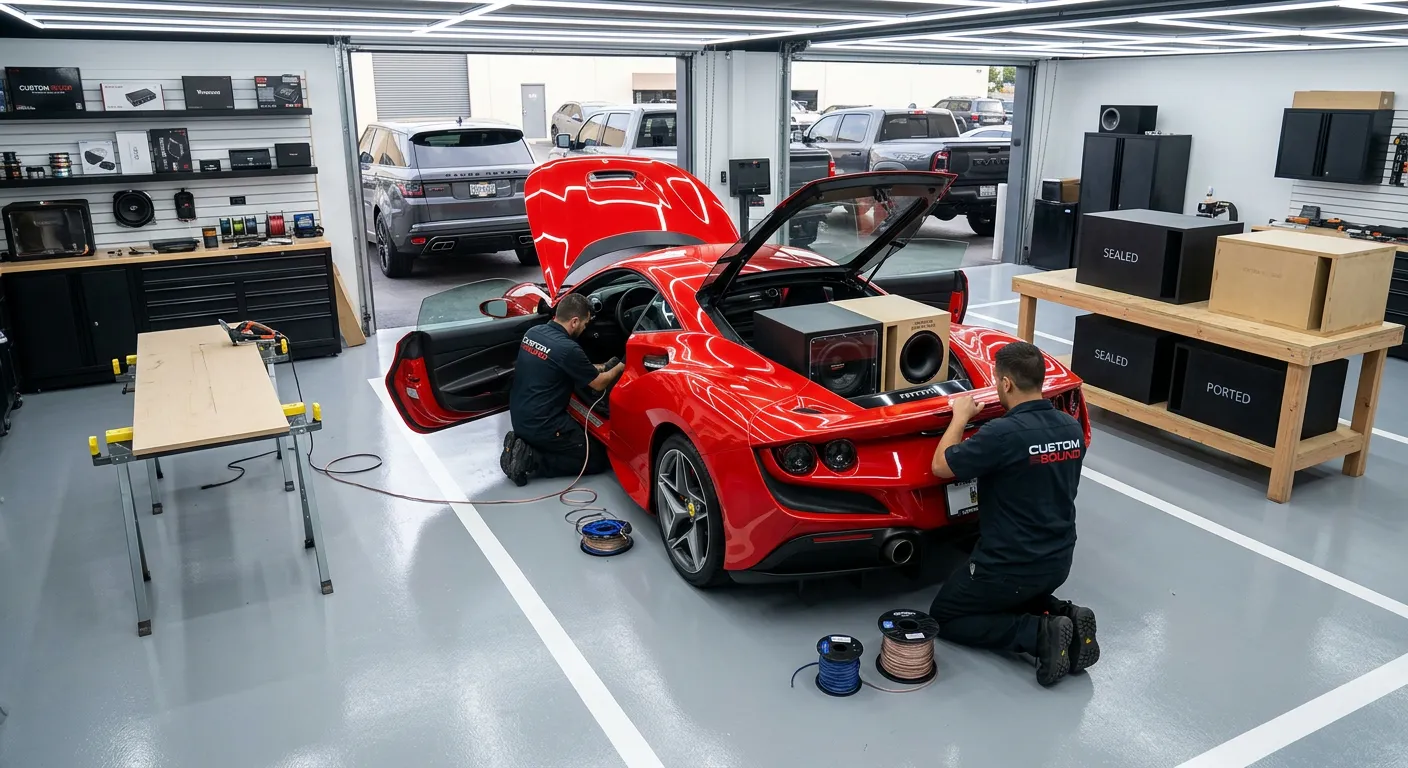
Sealed vs Ported Subwoofer Boxes is one of the first comparisons to make when adding bass to a car, truck, or SUV. Both enclosure styles can sound great when the subwoofer, enclosure, amplifier, and vehicle are properly matched. The difference comes down to how each box controls the subwoofer and how you want the bass to sound.
A sealed enclosure is completely closed and uses the trapped air inside the box to help control cone movement. These boxes are commonly associated with tight, controlled bass and can often use less space than a comparable ported enclosure.
A ported enclosure adds a tuned vent or slot. The port works with the subwoofer and enclosure volume to increase output around its tuning range. Ported boxes can produce more output, but proper enclosure volume and port tuning matter.
At Notorious Auto Protection, we provide car subwoofer installation and other car audio services in Syracuse, NY.
If you are trying to decide which box belongs in your vehicle, start with the sound you want, the space you have, and the subwoofer you plan to use.
A subwoofer enclosure does much more than hold the speaker.
The enclosure affects how the subwoofer cone moves and how the sound waves from the front and rear of the speaker interact.
KICKER explains that an enclosure can improve bass response and help prevent excessive cone movement. The manufacturer also notes that enclosure design should be matched to the subwoofer and the sound the listener wants.
Rockford Fosgate describes the enclosure as controlling the air behind the speaker while preventing the front and rear low-frequency waves from canceling each other.
That is why putting an expensive subwoofer into the wrong box can produce disappointing results.
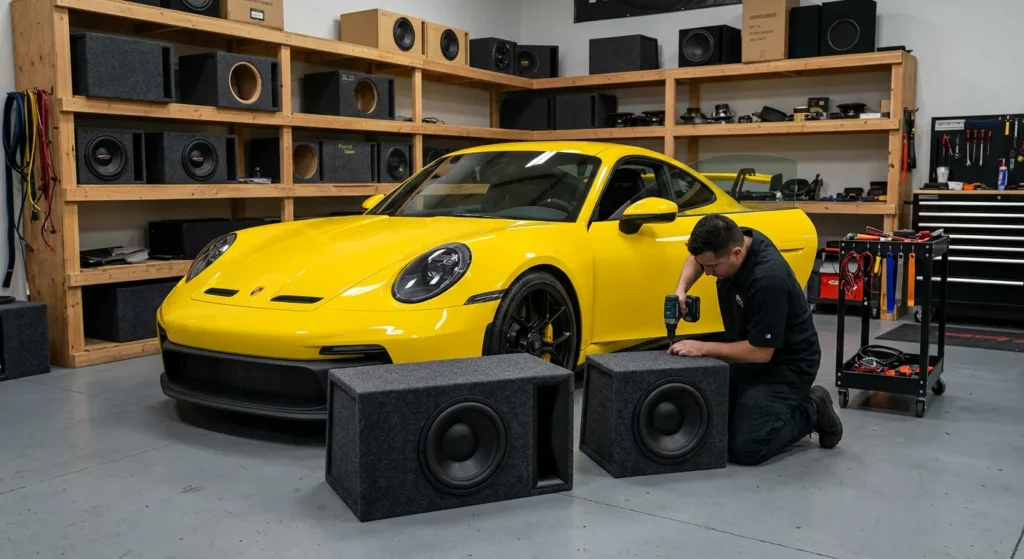
The enclosure is part of the audio system.
The basic Sealed vs Ported Subwoofer Boxes comparison looks like this.
A sealed box:
A ported box:
Neither design is automatically the right choice for every vehicle.
The answer depends on what you want to hear.
A sealed enclosure is an airtight box with the subwoofer mounted into it.
There is no port.
KICKER refers to this design as an acoustic suspension enclosure because the trapped air inside acts like a spring that helps control movement of the subwoofer cone.
Box volume still matters.
A sealed box cannot simply be made as small or large as you want.
Subwoofer manufacturers publish recommended enclosure volumes for their speakers.
KICKER notes that smaller sealed boxes can provide tighter bass and stronger cone control, while larger sealed boxes can produce smoother and deeper bass within the manufacturer’s recommended range.
That means even two sealed boxes using the same subwoofer can sound different.
Sealed enclosures are commonly chosen by listeners who want controlled and accurate bass.
KICKER describes properly built sealed enclosures as having tight bass response and a smooth low-frequency roll-off.
Rockford Fosgate also describes sealed boxes as providing tighter and more accurate bass reproduction.
This type of sound can work well when you want bass notes to sound defined rather than emphasizing a narrow frequency range.
A sealed enclosure can be a good match for someone who listens to many types of music and wants the subwoofer to blend with the rest of the system.
It can also work well when cargo or cabin space is limited.
A ported enclosure is also called a vented or bass-reflex enclosure.
It contains an opening designed around a certain area and length.
That port is not simply a hole in the box.
KICKER explains that the port works with the enclosure air volume and subwoofer to increase output around the enclosure’s tuning frequency.
The manufacturer also warns that enclosure volume, vent area, and vent length need to be correct.
A poorly designed ported box can reduce performance rather than improve it.
Ported enclosure design needs to account for:
That is why cutting a hole into a sealed enclosure does not turn it into a properly designed ported box.
Ported boxes are commonly chosen when the listener wants more bass output.
KICKER states that vented enclosures can increase output around their tuning frequency.
Rockford Fosgate makes a similar distinction, describing ported boxes as producing greater output with a stronger low-end character than sealed designs.
How the box sounds depends heavily on tuning.
A ported enclosure can be designed around lower bass or a different frequency range based on the subwoofer and the builder’s goals.
That flexibility also makes the design less forgiving of mistakes.
The port and box need to work together.
A properly designed ported enclosure can provide more output around its tuning range than a sealed enclosure using the same subwoofer.
KICKER states that ported designs increase output around the vent’s tuning frequency.
Its enclosure guidance also notes that ported systems can make more use of a subwoofer’s output around that range.
This does not mean every ported box will outperform every sealed box.
Results depend on:
A badly designed ported enclosure can sound worse than a properly built sealed box.
Box type alone does not determine how loud a complete system will be.
If by “tight” you mean controlled bass with a smooth response, a sealed enclosure is often associated with that sound.
KICKER describes smaller sealed enclosures as producing tight and controlled bass.
Rockford Fosgate also associates sealed boxes with tighter bass reproduction.
That does not mean a ported system must sound sloppy.
A properly designed ported enclosure can sound very good.
The difference is that the port contributes to output around the tuned range, while the sealed enclosure relies on the subwoofer operating against the enclosed air volume.
Your subwoofer choice and box design still matter more than simply attaching the words “sealed” or “ported” to the system.
This question needs more than a one-word answer.
Both designs can reproduce deep bass.
KICKER notes that larger sealed enclosures within the recommended range can produce deeper and smoother bass than smaller sealed boxes.
A properly designed ported enclosure can also produce strong low-frequency output around its intended tuning range.
KICKER’s current CompQ documentation says its vented enclosures are intended for buyers seeking high output and low-frequency extension, with larger recommended vented boxes producing more bass at the lowest frequencies.
The difference appears below the ported enclosure’s tuning range.
KICKER states that a sealed enclosure rolls off more gradually, while a ported enclosure has a steeper low-frequency roll-off.
The right answer depends on the subwoofer, enclosure design, and frequency range you want the system to reproduce.
Sealed enclosures are often smaller.
Rockford Fosgate notes that sealed boxes can fit into more vehicles because they generally require less space than ported designs.
Ported boxes need room for both the subwoofer’s required air volume and the port.
A port itself takes up internal enclosure space.
A low-tuned port can also require considerable length.
KICKER explains that lower tuning often requires a longer vent and more enclosure space.
That matters in vehicles where every inch counts.
Truck owners may have limited room behind or under a seat.
Car owners may still want usable trunk space.
SUV owners may not want a large enclosure occupying the cargo area.
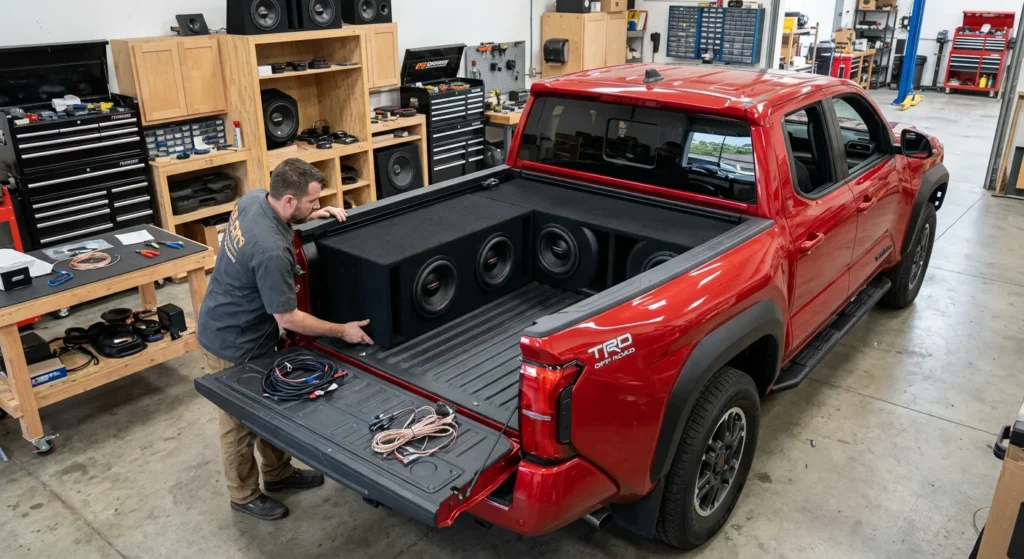
Measure the available space before selecting the box.
Port tuning is one of the biggest differences between sealed and ported designs.
A port has to be sized for the enclosure and intended tuning frequency.
KICKER states that the vent interacts with the enclosure volume and driver to increase output around the tuning frequency.
Change the port dimensions and you change how the enclosure behaves.
Port design involves factors such as:
Port placement matters too.
KICKER advises leaving enough clearance around a port so airflow is not restricted.
An obstructed port can change how the enclosure operates.
This is one reason a ported box should be designed for the specific subwoofer rather than built around whatever dimensions happen to fit.
This is worth understanding before choosing a ported box.
KICKER explains that a ported enclosure loses much of its control over subwoofer cone movement below the enclosure’s tuning frequency.
The company refers to this as unloading.
At frequencies sufficiently below tuning, excessive cone movement can increase the chance of subwoofer damage.
System design and amplifier filtering can help manage this concern.
The correct setup depends on the subwoofer, box, amplifier, and tuning frequency.
This is another reason to treat the subwoofer, enclosure, and car amplifier as parts of one system.
A sealed enclosure may require more amplifier power to reach the same sound-pressure level as a ported system around the ported box’s tuning range.
Rockford Fosgate notes that sealed enclosures can require more amplifier power to produce comparable output.
That does not mean you should simply install the largest amplifier available.
Amplifier output needs to match the subwoofer’s specifications and wiring configuration.
Check:
Peak or maximum wattage numbers should not be the only figures used to pair the equipment.
For a complete installation, Notorious Auto Protection provides both car subwoofer and car amplifier services.
Not every subwoofer belongs in every enclosure.
Some subwoofers are designed to work in both sealed and ported boxes.
Others may be better suited to a particular enclosure.
Manufacturers publish enclosure recommendations for a reason.
KICKER’s current CompVX 10-inch subwoofer, as one example, is listed for use with sealed or ported enclosures.
The recommended air volume and construction requirements still need to be followed for whichever design is chosen.
Do not buy a subwoofer and assume any box with the correct cutout diameter will work.
A 12-inch subwoofer does not automatically belong in every 12-inch enclosure.
Driver diameter is only one measurement.
Music preference can help narrow the choice, but avoid rigid rules.
You can listen to hip-hop with a sealed box.
You can listen to rock with a ported box.
Neither enclosure knows what genre is playing.
What matters is the type of bass reproduction you enjoy.
A sealed enclosure may appeal to you if you like clear bass notes and a smooth response.
KICKER associates smaller sealed enclosures with punchy, controlled bass.
That can work well with music containing fast kick drums and bass notes where definition matters.
A ported enclosure may be worth considering when stronger output around the tuned frequency is the goal.
Rockford Fosgate notes that ported enclosures are popular when listeners want stronger low-frequency output.
This can suit music with sustained low bass, depending on the enclosure tuning.
Do not assume a mixed playlist requires one particular box.
Tell your installer what you listen to and what you dislike about your current system.
“I want bass that I can feel but I don’t want it overpowering the vocals” is often more useful than naming one music genre.
Truck installations often have strict space limits.
Depending on the cab, the enclosure may need to fit:
A sealed enclosure can be attractive when available airspace is limited.
A ported truck box can work too, provided there is enough room for the correct enclosure volume and port.
Do not shrink a ported design below the subwoofer manufacturer’s recommendations simply to make it fit.
If the proper ported enclosure will not fit, a suitable subwoofer in a correctly sized sealed box may be a better direction than forcing the wrong enclosure into the available space.
Cars and SUVs can provide more enclosure space, but the cabin and cargo layout still affect the installation.
A sedan may place the subwoofer in the trunk.
An SUV may have the enclosure in an open cargo area connected directly to the passenger cabin.
That changes how you experience the bass.
Cargo use matters too.
If you regularly carry luggage, tools, sports equipment, or other items, a huge enclosure may not make sense for daily use.
Start by deciding how much space you are willing to give up.
Then select a subwoofer and enclosure combination that can work within that space.
Where the subwoofer and port face can affect how the system sounds inside a vehicle.
Possible orientations include:
The best choice depends on the vehicle, enclosure, subwoofer, available clearance, and installation.
A port also needs breathing room.
KICKER warns against positioning a port directly against a solid surface because restricted airflow can affect its operation.
Do not load cargo tightly against a ported enclosure’s vent.
The port needs room to move air.
A good subwoofer can perform poorly when the enclosure or system is mismatched.
Here are several problems worth avoiding.
A 10-inch, 12-inch, or 15-inch label does not tell you the required enclosure volume.
Use the manufacturer’s specifications for the exact subwoofer model.
A random opening does not create a properly tuned ported enclosure.
Port area and length need to match the enclosure and desired tuning.
The outside dimensions do not tell the whole story.
Subwoofer and port displacement affect usable internal airspace.
A port needs clearance.
Do not place it directly against a seat, wall, cargo, or another surface in a way that restricts airflow.
The enclosure cannot correct a poor amplifier and subwoofer match.
Think about how the system will sound during normal daily listening, not only how loud it can become.
Bass is one part of a vehicle audio system.
If the subwoofer becomes much louder than everything else, you may decide the rest of the system also needs attention.
Notorious Auto Protection offers related services including:
Planning the system together makes it easier to match the subwoofer, amplifier, speakers, and source unit around the sound you want.
Notorious Auto Protection provides car subwoofer installation in Syracuse, NY.
Our shop is located at:
Notorious Auto Protection
6742 Pickard Dr
Syracuse, NY 13211
When deciding between Sealed vs Ported Subwoofer Boxes, think about four things first:
If you want tight, controlled bass and need to conserve space, a properly sized sealed enclosure may fit your plans.
If you want more output around a chosen bass range and have room for a larger, correctly tuned enclosure, a ported design may be a better match for that goal.
The box still needs to be designed for the subwoofer.
Sealed vs Ported Subwoofer Boxes is not a contest with one winner.
Each design produces different results.
Sealed enclosures are known for controlled bass, compact packaging, and a gradual low-frequency roll-off.
Ported enclosures use a tuned vent to add output around a selected frequency range. They commonly need more space and more careful box design.
Your subwoofer, amplifier, vehicle, available space, and listening preferences should decide the setup.
If you are planning a subwoofer system in Syracuse, NY, call Notorious Auto Protection at (315) 552-4441.
You can also visit our contact page to schedule an appointment.
Our hours are Monday through Saturday from 8 AM to 6 PM and Sunday from 8 AM to 5:30 PM.
Neither is better for every listener. Sealed boxes are commonly chosen for controlled, accurate bass and smaller enclosure sizes. Ported boxes can produce greater output around their tuning frequency. Your preferred sound, available space, subwoofer, and amplifier should guide the choice.
A properly designed ported enclosure can provide more output around its tuning frequency. KICKER explains that the vent works with the subwoofer to increase output around this range. Total system output still depends on the subwoofer, amplifier, box design, and vehicle.
Yes. KICKER notes that larger sealed enclosures within a subwoofer’s recommended range can provide smooth, deep bass. Sealed enclosures also have a more gradual low-frequency roll-off than ported boxes.
Ported enclosures commonly require more space because the design needs enough internal volume for the subwoofer along with the port. Rockford Fosgate notes that ported boxes are generally larger than sealed enclosures.
You should not simply cut a random hole into a sealed enclosure. A ported box requires the correct internal volume, port area, port length, and tuning for the subwoofer. KICKER warns that incorrect enclosure and port dimensions can reduce performance or contribute to subwoofer damage.
A sealed enclosure can require more amplifier power to reach the same output level that a ported enclosure produces around its tuned range. The amplifier should still be matched to the subwoofer’s RMS power and impedance specifications rather than selected only by box type.
Notorious Auto Protection provides car subwoofer installation at 6742 Pickard Dr, Syracuse, NY 13211. We can also work with car amplifiers, speakers, and complete car audio systems. Call (315) 552-4441 or use our contact page to schedule an appointment.

Your vehicle is a significant investment, and ensuring its protection from the elements and everyday hazards is crucial to maintaining its value and appearance. In Syracuse, NY, where road conditions and weather can be unpredictable, combining STEK Paint Protection Film (PPF) and Window Tint offers the ultimate solution for safeguarding your car. At Notorious Auto Protection, we specialize in applying these premium products to provide your vehicle with maximum protection and enhanced aesthetics.
Product Brand: Auto Protection
Question about the service you're choosing, or simply ready to book? Contact us today to get started
Explore the many services we offer by clicking the boxes below