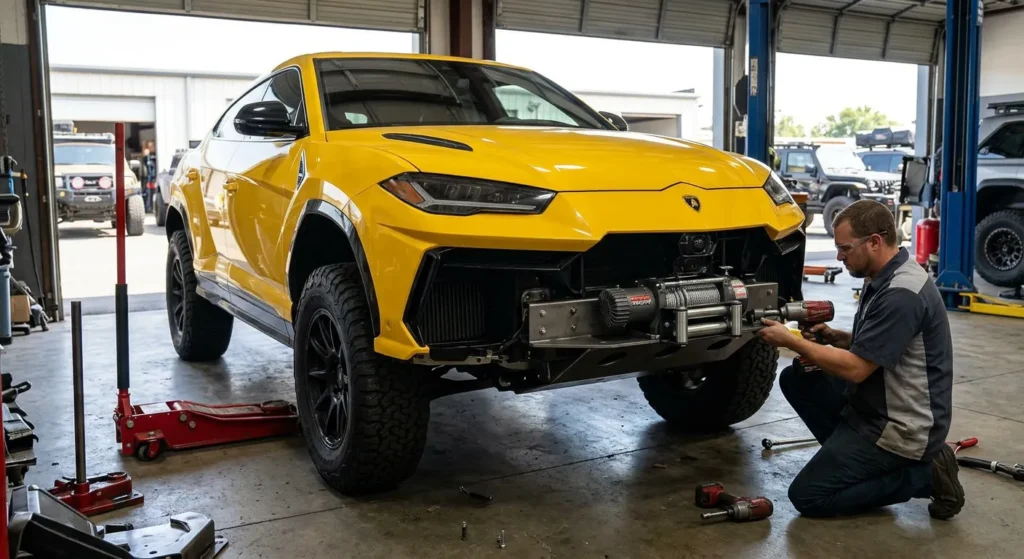
Winch Installation starts with choosing a winch that is properly sized for your truck and the type of recovery work you expect it to handle. A winch that looks right on the bumper is not necessarily sized correctly for the vehicle. Truck weight, rated line pull, mounting compatibility, electrical demands, rope type, recovery conditions, and safe attachment points all need to be considered.
One commonly cited starting point is choosing a winch with a rated pulling capacity of at least 1.5 times the vehicle’s gross vehicle weight rating, or GVWR. WARN, a major winch manufacturer, recommends this 1.5-times-GVWR calculation as a minimum starting point when sizing a truck winch.
That calculation is useful, but capacity is only one part of the setup.
The winch also needs a compatible mounting system, adequate electrical support, properly rated recovery equipment, and a safe installation.
Notorious Auto Protection provides winch installation and other truck accessories in Syracuse, NY.
Here is what truck owners should know before selecting a winch.
Winches are commonly advertised using a rated line-pull figure.
You may see truck winches labeled:
These numbers refer to pulling capacity under defined conditions rather than the weight of a truck that the winch can always recover under every circumstance.
WARN explains that winch capacity is rated on the first layer of rope around the drum.
As more rope winds onto the drum, pulling capacity decreases.
This distinction matters when comparing winches.
A 12,000-pound rating does not mean the winch delivers exactly 12,000 pounds of pulling force at every point during a recovery.
A common starting point for Winch Installation is:
Winch capacity = GVWR × 1.5
WARN recommends choosing a winch rated for at least 1.5 times the vehicle’s GVWR.
This provides a straightforward way to begin narrowing your choices.
It is still a starting calculation.
The final selection should also consider:
Do not choose a winch simply because another truck owner uses the same model.
Two trucks that look similar may have different GVWR figures and very different equipment.
GVWR stands for Gross Vehicle Weight Rating.
NHTSA defines GVWR as the value specified by the manufacturer as the loaded weight of a single vehicle.
You can find vehicle weight information on the certification label attached to the vehicle.
The exact label location varies, but it is commonly found around the driver’s door or door-jamb area.
Use the rating for your truck rather than estimating its weight from memory.
Winch sizing should be based on reliable vehicle information.
The 1.5-times-GVWR guideline is easy to calculate.
Suppose a truck has a GVWR of 7,000 pounds.
The calculation would be:
7,000 × 1.5 = 10,500 pounds
Using WARN’s guideline, you would start by looking for a winch rated at no less than 10,500 pounds.
Since winches come in set capacity ranges, you would need to choose an available winch that meets or exceeds that calculated minimum.
Here is another calculation.
A truck with an 8,000-pound GVWR would produce:
8,000 × 1.5 = 12,000 pounds
That points toward a winch with at least a 12,000-pound rating under the same guideline.
These calculations do not account for every recovery condition.
They simply establish a useful starting capacity.
Pulling a freely rolling truck on hard, level pavement is different from recovering one stuck in mud.
A vehicle can create additional resistance when:
This is why choosing a winch based only on the vehicle’s curb weight can leave out part of the picture.
Recovery conditions affect the load placed on the equipment.
Your expected use matters when choosing a winch.
Rated line pull is the maximum pulling force assigned to a winch under the manufacturer’s specified conditions.
For many electric truck winches, the advertised capacity applies to the first layer of rope on the drum.
WARN states that maximum pulling power occurs on the first layer.
The physical reason involves the effective drum diameter.
As additional layers of rope build around the drum, the diameter increases.
That changes the mechanical relationship between the drum and rope.
The result is less available pulling force as the drum fills.
Picture the winch drum with only one layer of rope wrapped around it.
That is where many winches produce their highest line pull.
Now add several layers.
The rope is farther from the center of the drum.
WARN’s technical information shows that line pull decreases as rope layers accumulate.
This has a practical effect during recovery.
When conditions allow, having more rope extended from the drum can place the winch closer to its stronger lower layers.
Do not unwind the winch beyond the minimum number of wraps specified by the manufacturer.
The owner’s manual for the exact winch should determine how much rope must remain on the drum.
Most recreational truck owners are familiar with electric winches.
An electric winch uses the truck’s electrical system to power its motor.
Hydraulic winches are another category and use hydraulic power.
For many personal trucks, Jeeps, SUVs, and recreational off-road vehicles, electric winches are common because they can be installed as self-contained recovery systems with suitable electrical connections.
Electric winches place substantial demands on the battery and charging system when pulling under load.
That makes electrical planning part of the installation.
Truck winches can use synthetic rope or steel cable, depending on the winch and setup.
Each has different characteristics.
Synthetic rope is lighter and easier to handle than comparable steel cable.
WARN sells many of its truck winches with synthetic rope and provides separate guidance for rope inspection and use.
Synthetic rope still needs inspection.
Cuts, abrasion, heat damage, contamination, and other deterioration can affect its condition.
Steel cable has long been used on vehicle winches.
It can withstand certain abrasive environments well, but it requires careful handling.
Steel cable can develop:
Never grab damaged steel cable with bare hands.
Follow the winch manufacturer’s inspection and replacement instructions.
A powerful winch is only useful when it is mounted to a system designed to handle it.
The mounting plate, bumper, and related hardware need to be compatible with the truck and winch.
WARN advises users to select a mounting system designed for their particular vehicle and winch.
A decorative bumper is not automatically a winch bumper.
Likewise, an aftermarket bumper that has space for a winch does not automatically accept every winch model.
Check:
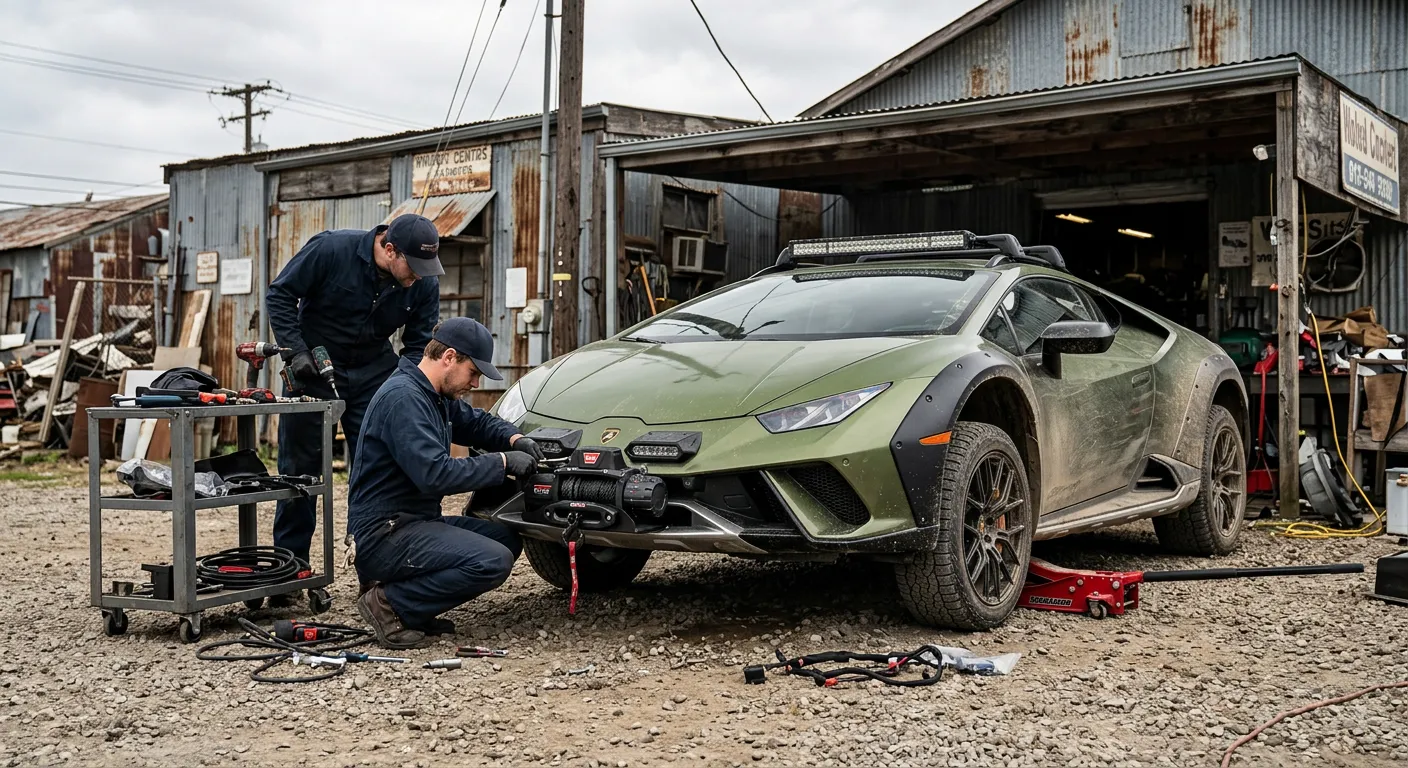
Notorious Auto Protection provides bumper installation along with winch installation, which can be useful when the recovery setup involves both components.
Many off-road trucks mount the winch in or behind the front bumper.
Fitment should be planned before buying either component.
A larger-capacity winch can also be physically larger.
Check whether the bumper or winch plate was designed for:
The installation should not be treated as a matter of making the winch physically fit into an opening.
The mounting system needs to be intended for winching loads.
Electric winches can draw substantial electrical current.
WARN publishes electrical specifications for individual winch models, including current draw at different loads.
As winch load rises, current demand can increase considerably.
That is why battery condition and electrical connections matter.
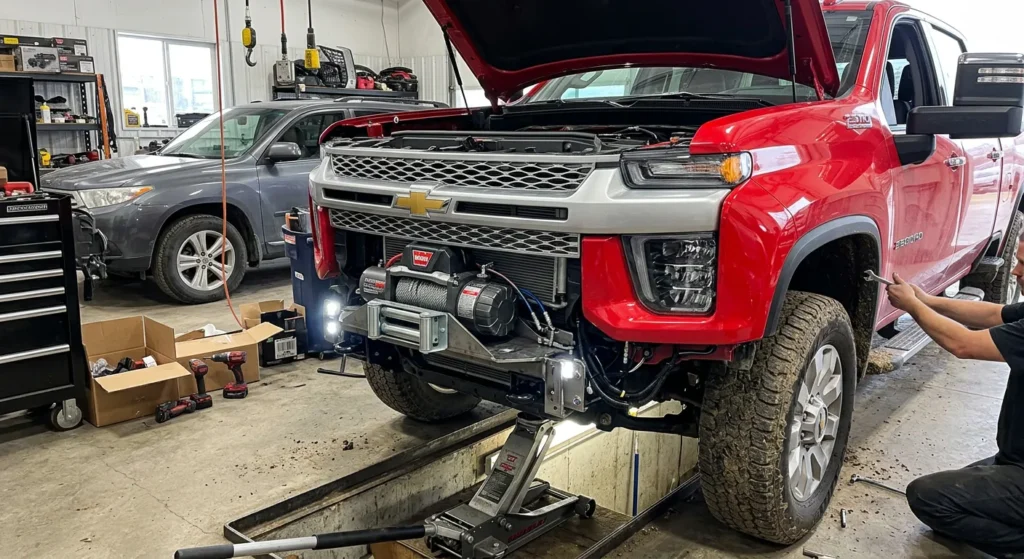
A truck winch installation can involve:
Follow the wiring instructions supplied with the winch.
Do not substitute undersized electrical cable because it is easier to route.
The winch is only one part of a recovery system.
The vehicle also needs suitable recovery points and properly rated equipment.
Do not assume a transport tie-down point is automatically intended for vehicle recovery.
The same caution applies to bumpers and hitches.
Recovery forces can be high.
Use attachment points and accessories designed and rated for the intended recovery load.
Your recovery setup may include:
Follow the ratings and instructions for each component.
The capacity of the winch does not make an underrated attachment point stronger.
A stuck truck can require more force to move than its static vehicle weight suggests.
Mud can hold tires.
Snow can build resistance.
A slope introduces another force that the winch must work against.
A vehicle with damaged running gear may not roll normally.
Recovery direction matters too.
Winches are generally intended to pull as straight as practical.
Side loading can create problems with rope spooling and equipment loading.
If the recovery cannot be performed as a straight pull, use recovery methods and accessories approved by the winch manufacturer.
A pulley block can change the direction of a winch line or be incorporated into a double-line pull.
WARN describes double-line rigging as a method that can increase pulling power while reducing the load on the winch.
The exact rigging method matters.
A pulley block, anchor point, straps, shackles, and other equipment all need suitable ratings.
Do not treat a pulley as permission to ignore the ratings of the rest of the recovery system.
Every loaded part needs to be appropriate for the forces involved.
A winch can produce enormous force.
Treat the rope, cable, hooks, shackles, anchor points, and mounting system accordingly.
WARN’s winch safety guidance includes several precautions that truck owners should learn before using a winch.
These include:
Never step over a tensioned winch line.
Never use the winch rope or cable as a tow strap.
Do not use a winch as a hoist unless the product is expressly designed and approved for that purpose.
A daily-driven truck can still benefit from a winch, especially when it also sees trail use, winter travel, hunting trips, property work, or other situations where vehicle recovery may be needed.
Daily use introduces other considerations.
The winch and bumper can add weight to the front of the vehicle.
That added weight may affect:
Check your truck’s ratings before adding heavy accessories.
If several accessories are planned, consider them as one build rather than separate projects.
A heavy bumper, winch, larger tires, lighting, and other accessories all add weight.
Off-road use places more attention on recovery planning.
A truck used on trails may encounter:
A properly selected winch can be part of a larger recovery setup.
Truck owners building for off-road use may also consider:
Plan the vehicle around how it will actually be driven.
Choosing a winch that exceeds the minimum calculated capacity can make sense in some truck builds.
That does not mean buying the largest winch that physically exists.
A larger winch may:
Start with the vehicle’s GVWR and the winch manufacturer’s sizing recommendations.
Then look at the actual truck, expected recovery conditions, bumper, mounting system, and electrical setup.
Capacity should be matched to the vehicle rather than chosen as a bragging number.
Truck owners can avoid several problems by planning the entire recovery setup before buying parts.
WARN recommends using GVWR for its 1.5-times sizing guideline.
Check your truck’s actual certification information.
Confirm mounting compatibility first.
A high-capacity electric winch can draw considerable current under load.
Follow the electrical specifications for the exact model.
The bumper and winch add weight to the truck.
Keep vehicle weight ratings and suspension condition in mind.
Shackles, straps, pulley blocks, and recovery points need suitable ratings too.
Learn how your equipment operates before you need it during a difficult recovery.
Read the manual and become familiar with the controls, free-spool operation, rope, and rigging.
Notorious Auto Protection provides winch installation for truck owners in Syracuse, NY.
Our shop is located at:
Notorious Auto Protection
6742 Pickard Dr
Syracuse, NY 13211
Before installation, consider your truck’s GVWR, intended use, winch capacity, bumper or mounting system, electrical requirements, and recovery equipment.
We also provide related truck services, including:
Planning the bumper, winch, electrical connections, and related accessories together can prevent fitment problems later.
Winch Installation begins with sizing the equipment to the truck.
WARN recommends a winch capacity of at least 1.5 times the vehicle’s GVWR as a starting point.
From there, check the mounting system, electrical requirements, rope or cable, recovery points, and the type of recovery work you expect to perform.
Do not choose a winch by capacity alone.
The complete recovery system needs to work together.
For winch installation in Syracuse, NY, call Notorious Auto Protection at (315) 552-4441.
You can also visit our contact page to schedule an appointment.
Our hours are Monday through Saturday from 8 AM to 6 PM and Sunday from 8 AM to 5:30 PM.
WARN recommends choosing a winch rated for at least 1.5 times your truck’s GVWR. If the GVWR is 8,000 pounds, that calculation gives a 12,000-pound minimum starting capacity. Check the recommendations for the exact winch and vehicle before making a final selection.
WARN’s truck winch sizing guidance uses GVWR. NHTSA defines GVWR as the manufacturer’s specified loaded weight rating for the vehicle. Check the certification information on your truck rather than estimating.
It depends on your truck’s GVWR and intended use. Under WARN’s 1.5-times-GVWR guideline, a 12,000-pound winch corresponds to a truck with a GVWR of up to 8,000 pounds as a starting calculation. Recovery conditions and manufacturer requirements still need to be considered.
Both are used for vehicle winching. Synthetic rope is lighter and easier to handle, while steel cable has different abrasion and durability characteristics. Either type requires inspection, correct handling, and replacement when damaged. Follow the winch manufacturer’s instructions.
The winch needs a mounting system designed to support it and its pulling loads. Some aftermarket bumpers incorporate a winch mount, while other setups use a separate mounting plate. Check vehicle, bumper, mount, and winch compatibility before installation.
Electric winches can draw high current, especially under heavy load. Battery condition, cable size, connections, and the vehicle’s electrical system all matter. Use the electrical specifications and installation instructions supplied by the winch manufacturer.
Notorious Auto Protection provides winch installation at 6742 Pickard Dr, Syracuse, NY 13211. Call (315) 552-4441 or visit our contact page to schedule an appointment.

Your vehicle is a significant investment, and ensuring its protection from the elements and everyday hazards is crucial to maintaining its value and appearance. In Syracuse, NY, where road conditions and weather can be unpredictable, combining STEK Paint Protection Film (PPF) and Window Tint offers the ultimate solution for safeguarding your car. At Notorious Auto Protection, we specialize in applying these premium products to provide your vehicle with maximum protection and enhanced aesthetics.
Product Brand: Auto Protection
Question about the service you're choosing, or simply ready to book? Contact us today to get started
Explore the many services we offer by clicking the boxes below