Window Tinting in Hamilton, NY gives Madison County drivers several choices when deciding how they want their vehicle’s glass to look and perform. Tint film is not just about making windows darker. The film type, visible light transmission, UV rejection, infrared performance, glare reduction, and New York tint rules all deserve attention before you choose a product.
That is where the differences between basic dyed films, carbon films, and ceramic films become useful.
A driver interested mainly in appearance may have different needs from someone focused on heat rejection. Another vehicle owner may want a lighter film with strong UV rejection instead of a dark appearance. The right choice depends on the vehicle, glass, legal limits, and what you expect from the film.
Notorious Auto Protection provides window tinting at our Syracuse, NY shop for drivers throughout Central New York. We work with XPEL and Ceramic Pro window film products and can discuss film choices with Hamilton, NY drivers who are considering a trip to our shop.
Here is what to know before choosing your tint.
Automotive window tint is a thin film applied to vehicle glass.
Different films are built to provide different levels of visible light transmission, UV rejection, infrared rejection, glare reduction, and appearance.
That distinction matters because two films that look similar from outside the vehicle can have different performance specifications.
Window tint can be selected around goals such as:
Film selection should start with the performance you want rather than choosing only by how dark a sample looks.
Drivers researching Window Tinting in Hamilton, NY will commonly encounter several types of automotive film.
These include:
Manufacturers use their own materials, construction methods, and product names, so films within the same broad category can still have different specifications.
Notorious Auto Protection works with XPEL and Ceramic Pro products.
Both manufacturers offer several film choices, which makes it possible to compare options based on performance rather than treating all window tint as the same product.
Dyed window film uses a dyed layer to create its appearance and reduce the amount of visible light passing through the glass.
XPEL PRIME CS is one example.
XPEL describes PRIME CS as a color-stable dyed film. According to XPEL’s current product information, the PRIME CS range blocks 99% of harmful UV rays and is available in several shades.
A dyed film may appeal to a driver who mainly wants:
Heat-related performance differs between film families, so drivers focused heavily on infrared rejection may want to compare ceramic options as well.
Carbon-based films provide another option between traditional dyed products and some ceramic films.
Ceramic Pro’s KAVACA Carbon X uses nano-carbon and nano-ceramic particles.
Ceramic Pro’s technical sheet lists multiple VLT choices for Carbon X and reports 99.9% UV rejection across the listed shades.
This gives vehicle owners another way to choose film based on both appearance and published performance data.
When comparing carbon film, pay attention to the manufacturer’s specifications rather than assuming every product with “carbon” in its name performs the same way.
Ceramic tint uses ceramic-based technology rather than relying only on darkness to affect solar energy passing through the glass.
That makes ceramic films interesting for drivers who want strong infrared and UV performance without necessarily choosing the darkest available shade.
XPEL’s PRIME XR and XR PLUS families use nano-ceramic technology.
Ceramic Pro also offers KAVACA ceramic window film products.
The performance varies by product and VLT.
This is why asking only, “How dark is it?” leaves out useful information.
Ask about:
These specifications tell you much more about the film.
Notorious Auto Protection works with XPEL window tint products.
XPEL’s PRIME family includes several film types.
PRIME CS is XPEL’s color-stable dyed film.
It is designed for drivers who want a tinted appearance and UV rejection without moving into the company’s ceramic lines.
PRIME XR uses nano-ceramic technology.
XPEL’s current product information lists up to 85% infrared heat rejection for PRIME XR and 99% UV rejection.
Actual specifications depend on the selected film and shade.
PRIME XR PLUS is another nano-ceramic option with higher published infrared performance.
XPEL’s U.S. specification sheet lists multiple VLT levels for XR PLUS.
The sheet reports 99% UV rejection across its listed XR PLUS products, while infrared and total solar energy figures vary with film selection.
For Hamilton, NY drivers comparing XPEL products, the choice can be based on the balance you want between appearance, visible light, and solar performance.
Notorious Auto Protection also works with Ceramic Pro products.
Ceramic Pro’s KAVACA window film range includes products with different construction and performance specifications.
KAVACA Carbon X uses a blend of nano-carbon and nano-ceramic particles.
Ceramic Pro’s specification sheet lists several VLT options and 99.9% UV rejection.
KAVACA Ultimate IR uses nano-ceramic technology.
Ceramic Pro’s specification sheet lists film choices ranging from dark options to much lighter films.
The same sheet reports 99.9% UV rejection for the listed Ultimate IR products, while infrared rejection figures vary based on film and measurement method.
This range illustrates an important part of modern window tint.
Strong UV and infrared performance does not always require choosing the darkest film.
VLT means visible light transmission.
It describes how much visible light passes through the window system.
A higher VLT means more visible light passes through.
A lower VLT means less visible light passes through.
This means a 70% VLT is lighter than a 20% VLT.
One detail is easy to miss: the film’s stated VLT and the finished glass measurement are not always identical.
Vehicle glass already has its own light-transmission properties.
When film is applied, the glass and film work together.
Ceramic Pro’s specification sheet illustrates this by listing both film-only VLT and VLT measured on automotive glass. The numbers differ.
This matters in New York because tint legality is based on the amount of light passing through the window, not simply the number printed on a film sample.
Not necessarily.
Darkness and heat-related performance are not the same measurement.
Modern ceramic films can provide substantial infrared rejection at lighter VLT levels.
XPEL’s PRIME specification sheet shows this clearly. Its XR PLUS line includes several VLT choices while maintaining high published infrared rejection across the range.
Ceramic Pro’s KAVACA specifications show a similar pattern with lighter ceramic film choices that still provide infrared rejection.
What this means for a daily driver is simple.
Do not choose the darkest film just because you assume it will provide the strongest heat performance.
Compare the film specifications.
A lighter ceramic film may fit a driver’s needs better, especially when visible-light requirements limit how dark certain windows can legally be.
New York regulates how much visible light must pass through certain vehicle windows.
According to the New York State Department of Motor Vehicles inspection regulations, model-year 1992 and newer vehicles must allow at least 70% visible light transmission through the windshield below the top six inches and through side windows adjacent to or forward of the driver’s seating position.
Rear-window requirements depend on vehicle configuration, including whether the vehicle has dual outside rearview mirrors.
New York’s rules can differ depending on vehicle type and window location.
Because tint regulations and inspection requirements can change, check the current New York DMV rules for your exact vehicle before selecting film.
Do not choose a tint percentage based on what is legal in another state.
Hamilton, NY and Syracuse, NY are both subject to New York State requirements.
Yes.
Window tint is part of New York State vehicle inspection requirements.
The New York DMV inspection regulations include procedures for checking visible light transmission.
The regulations state that if a window clearly meets the required standard through observation, a meter may not be necessary. Windows that do not clearly meet the standard can be checked with a tint meter.
This makes legal film selection worth discussing before installation.
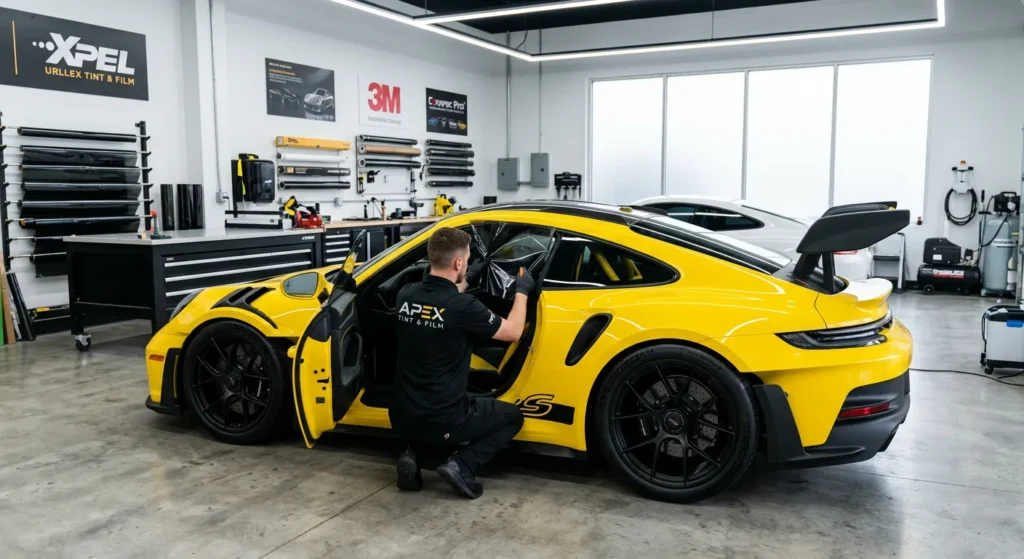
A film that looks good today can become frustrating if it creates a problem during a future New York State inspection.
New York provides a process for certain medical tint exemptions.
The New York DMV’s tinted-window exemption application states that the law provides an exemption for people who, for qualifying medical reasons, need protection from direct sunlight when other protective measures are not adequate.
The exemption applies only under the conditions established by New York regulations.
Drivers seeking a medical exemption should use the current DMV process rather than assuming a doctor’s note alone changes the tint requirements.
The New York DMV provides Form MV-80W for the application process.
Certain automotive window films are designed to reject a large percentage of UV radiation.
XPEL’s PRIME product information lists 99% UV rejection for its PRIME CS, XR, and XR PLUS film families.
Ceramic Pro’s KAVACA specification sheet lists 99.9% UV rejection for the Carbon X and Ultimate IR products shown on the sheet.
Those figures are manufacturer specifications for the listed products.
UV rejection is another reason not to judge window film only by darkness.
A lighter film can still have strong UV performance when designed for it.
Window film can reduce visible glare, with the amount depending on the selected film and shade.
XPEL’s PRIME specification sheet includes glare-reduction figures for its products.
As visible light transmission decreases, glare reduction can change as well.
That does not mean the darkest possible film is the right answer.
Visibility still matters, especially at night and during poor weather.
New York’s legal requirements also place limits on certain windows.
Choose a film that balances legal light transmission, driving visibility, and the appearance you want.
Factory privacy glass and aftermarket window film are not necessarily the same thing.
Many SUVs and trucks have darker rear glass from the factory.
That glass may create privacy without providing the same published solar performance as a selected aftermarket film.
If your vehicle already has dark rear glass, ask what adding a compatible film would change.
You may be interested in:
Remember that the finished VLT depends on the existing glass and the film applied to it.
Start with how you use your vehicle.
Look at lighter film options and compare their performance.
Ceramic films can provide strong UV and infrared rejection without requiring an extremely dark appearance.
Compare published infrared and total solar energy figures.
Do not use tint darkness as the only measure.
Look at the manufacturer’s UV specifications.
Both XPEL and Ceramic Pro publish high UV-rejection figures for several of their automotive film products.
Ask which windows can legally use the shade you want under current New York law.
Think carefully about visibility.
A shade that looks appealing during the day may feel very different on an unlit road at night.
The film needs to fit your actual driving habits.
Hamilton, NY drivers experience the same broad Central New York seasonal changes as other drivers in the region.
Summer sun, winter glare, changing daylight hours, snow, and nighttime driving can all affect what you want from vehicle glass.
Film selection should account for those real driving conditions.
A very dark film is not automatically a better film.
A premium ceramic film is not valuable just because it carries the ceramic label either.
Look at what the selected product actually does.
Compare VLT, infrared performance, UV rejection, glare reduction, and manufacturer warranty information.
Then make sure the selected film is suitable for the window where it will be installed under New York law.
Window film needs time to settle after installation.
Follow the aftercare instructions supplied for your film.
Ceramic Pro’s KAVACA aftercare guidance tells owners not to clean newly tinted windows for at least seven days after installation.
It also warns against using cleaners containing ammonia or alcohol on KAVACA window film because those chemicals can damage the film and affect warranty coverage.
Care instructions can differ between manufacturers.
After installation, ask:
Following the instructions for your exact film helps protect the finished installation.
Film selection is only one half of the job.
Installation affects how the finished tint looks.
Automotive glass can have curves, tight edges, door panels, seals, and other areas that require careful film placement.
The vehicle also needs to be matched with the appropriate film and legal VLT.
Working with an installer gives you a chance to compare actual film options before deciding.
You can discuss whether your goal is appearance, solar performance, UV rejection, glare reduction, or a combination of those factors.
Drivers searching for Window Tinting in Hamilton, NY can visit Notorious Auto Protection at our Syracuse, NY location.
Our shop is located at:
Notorious Auto Protection
6742 Pickard Dr
Syracuse, NY 13211
We provide window tinting using XPEL and Ceramic Pro products.
If you are also working on the exterior of your vehicle, Notorious Auto Protection provides:
Hamilton, NY drivers can discuss several vehicle appearance and protection services during the same visit to our Syracuse shop.
Window Tinting in Hamilton, NY starts with choosing a film based on more than shade.
Compare dyed, carbon, and ceramic film options.
Check the VLT.
Look at UV and infrared specifications.
Think about daytime and nighttime visibility.
Most of all, make sure the finished window meets current New York State requirements for your vehicle and window location.
Notorious Auto Protection works with XPEL and Ceramic Pro window film products at our Syracuse, NY shop.
If you are traveling from Hamilton, NY or elsewhere in Madison County, call (315) 552-4441 to discuss your vehicle and tint options.
You can also use our contact page to schedule an appointment.
Our hours are Monday through Saturday from 8 AM to 6 PM and Sunday from 8 AM to 5:30 PM.
The right film depends on your goals. A dyed film can provide a tinted appearance and UV rejection, while ceramic products can provide stronger infrared performance depending on the film. Compare VLT, UV rejection, infrared rejection, glare reduction, and New York requirements before choosing.
No. Ceramic technology and tint darkness are separate characteristics. XPEL and Ceramic Pro both offer ceramic films in multiple VLT levels. Some lighter ceramic films still have strong published UV and infrared performance.
VLT stands for visible light transmission. A 70% VLT measurement means 70% of visible light passes through the measured window system. Remember that film VLT and finished glass VLT can differ because the vehicle glass already affects light transmission.
New York’s rules depend on the window location, vehicle model year, and vehicle configuration. New York DMV inspection rules require at least 70% visible light transmission through certain windows on model-year 1992 and newer vehicles, including side windows adjacent to or forward of the driver’s seating position. Check current DMV rules for your exact vehicle before installation.
Yes. Window tint is included in New York State vehicle inspection regulations. Inspectors can check visible light transmission, including with a tint meter when needed.
Many modern films do. XPEL lists 99% UV rejection for several PRIME products, while Ceramic Pro’s KAVACA specification sheet lists 99.9% UV rejection for the Carbon X and Ultimate IR films shown. Check the specifications for the exact film you are considering.
Notorious Auto Protection provides window tinting at 6742 Pickard Dr, Syracuse, NY 13211. Hamilton, NY and Madison County drivers can call (315) 552-4441 or visit our contact page to schedule an appointment.
Your vehicle is a significant investment, and ensuring its protection from the elements and everyday hazards is crucial to maintaining its value and appearance. In Syracuse, NY, where road conditions and weather can be unpredictable, combining STEK Paint Protection Film (PPF) and Window Tint offers the ultimate solution for safeguarding your car. At Notorious Auto Protection, we specialize in applying these premium products to provide your vehicle with maximum protection and enhanced aesthetics.
Product Brand: Auto Protection
Question about the service you're choosing, or simply ready to book? Contact us today to get started
Explore the many services we offer by clicking the boxes below